

Hey folks,
So Meta got a patent. It’s weird. Trust me on this. They are so weird.
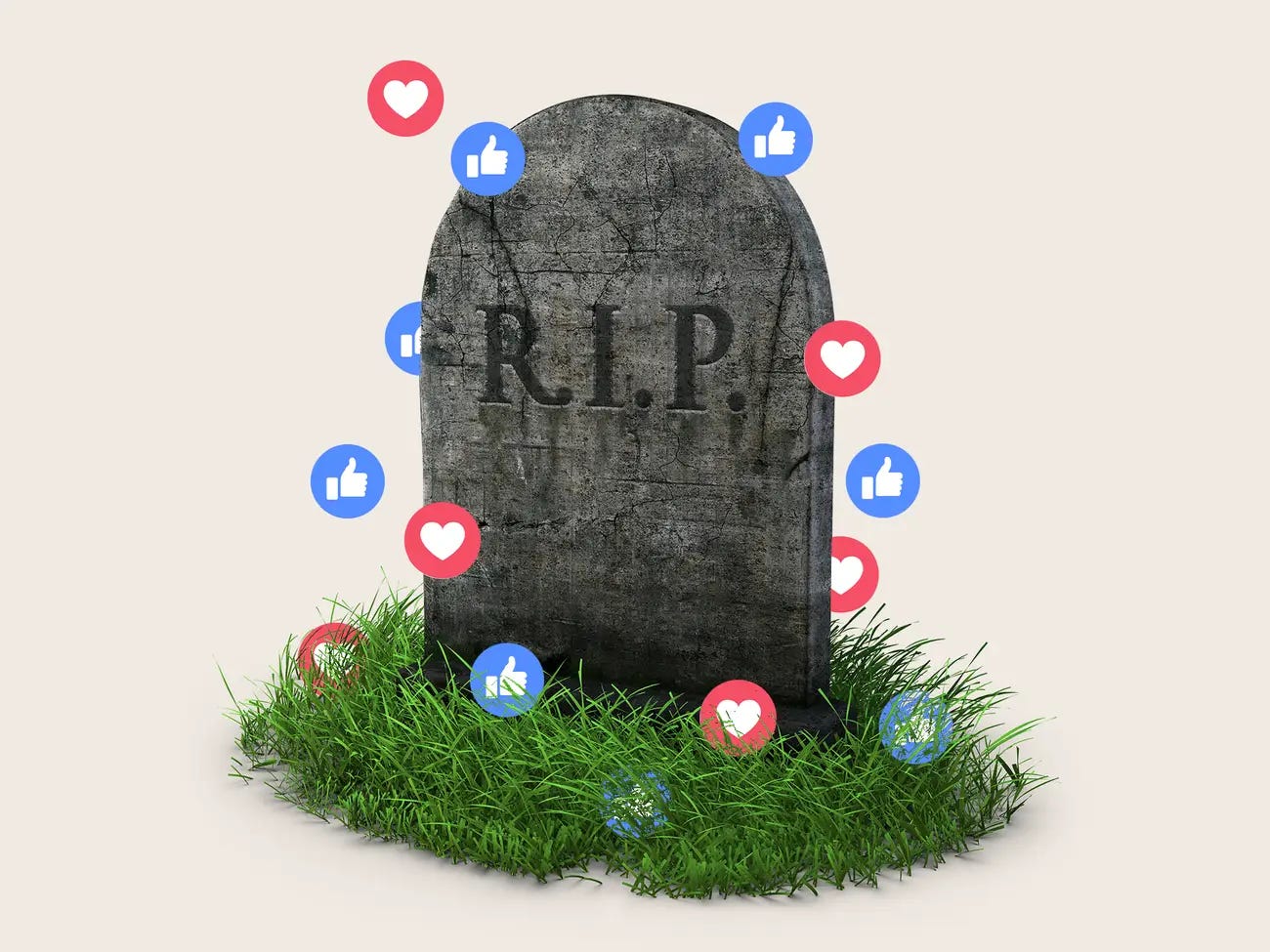
What is it? It’s a patent that lets an AI keep posting on your behalf after you die. Liking photos. Commenting on posts. Responding to DMs.
Basically a digital ghost that pretends to be you because, and I’m quoting the actual patent here, your followers’ “user experience will be affected” by your absence.
Let that sink in for a second.
Andrew Bosworth, Meta’s CTO, is the primary author. The patent was filed in 2023 and granted in December. Meta says they have “no plans to move forward” with it, which is what every company says about a patent they absolutely want to keep in their back pocket.
I’ve been thinking about this all week. Not because it’s competition — it’s not. But because it crystallizes something I’ve been wrestling with since I started building DeathNote.
Two Very Different Philosophies
Meta’s approach is to train an AI on your likes, comments, and behavior — then let it simulate you. The patent literally says it would handle video and audio calls. With dead people. Or at least, an AI that sounds like them.
DeathNote’s approach is the opposite. You sit down. You think about what matters. You write it yourself. You choose who gets it. And when the time comes, your actual words get delivered to the people you love.
One is a simulation. The other is a letter.
I don’t think there’s a debate about which one is more meaningful.
The Business of Grief
The article from Business Insider profiles a growing category they’re calling “grief tech” — startups like Replika, YOV, and others building tools around loss. This is so ick I can’t even stand it. Microsoft patented their own version of this back in 2021. Now Meta. The space is getting crowded and it’s getting mainstream.
Here’s another thing I find interesting: Every expert quoted in the article has concerns about AI simulating the dead. A sociology professor at UVA said, plainly, “Let the dead be dead.” And I agree. But I’d add something.
Let the dead be heard.
There’s a difference between an AI guessing what your mom would’ve said and reading the actual words she wrote for you. One is a parlor trick. The other is a gift.
Why This Matters for Us
I’m not going to pretend Meta’s patent doesn’t validate what we’re building. It does. When the CTO of a $1.5 trillion company authors a patent in your category, the market is real.
But validation isn’t the point. The point is that Big Tech will always optimize for engagement. More content. More data. More interaction. That’s the incentive structure. The patent says it explicitly — if you stop posting, the platform suffers.
We don’t have that incentive. DeathNote isn’t about keeping you “active” after you die. It’s about giving you a way to say what matters while you still can. And then respecting the silence after.
That’s it. That’s the whole thing.
The Ethical Line
I think about this a lot. Building in the death space means every feature decision carries weight. Should we add AI that writes your final messages for you? Technically, we could. We already have AI for eulogy drafts. But there’s a line between helping someone find the words and putting words in their mouth after they’re gone.
We’re staying on this side of that line.
Your messages are yours. Written by you. Encrypted by us. Delivered when it matters.
No ghost bots. No simulations. No AI pretending to be you in a group chat.
I don’t know if Meta will ever build what’s in that patent. Maybe they will. Maybe they’ll roll it out quietly as an opt-in feature on Instagram and people will sign up without reading the fine print, the way we all do.
And I certainly don’t trust them.
But if they do, I think people will eventually want something different. Something that doesn’t simulate the dead but honors them. Something that lets you say goodbye on your own terms.
That’s what we’re building. And it already works.
Talk soon,
— 8