

Hey folks!
This is the post I wish existed when I first started thinking about eulogies. Not the “top 10 tips” listicle. Not the AI-generated content farm version. The real, practical guide for someone who has been asked to write a eulogy and does not know where to begin.
If you are reading this because you actually need to write one right now — I am sorry for your loss. Let us get you through this.
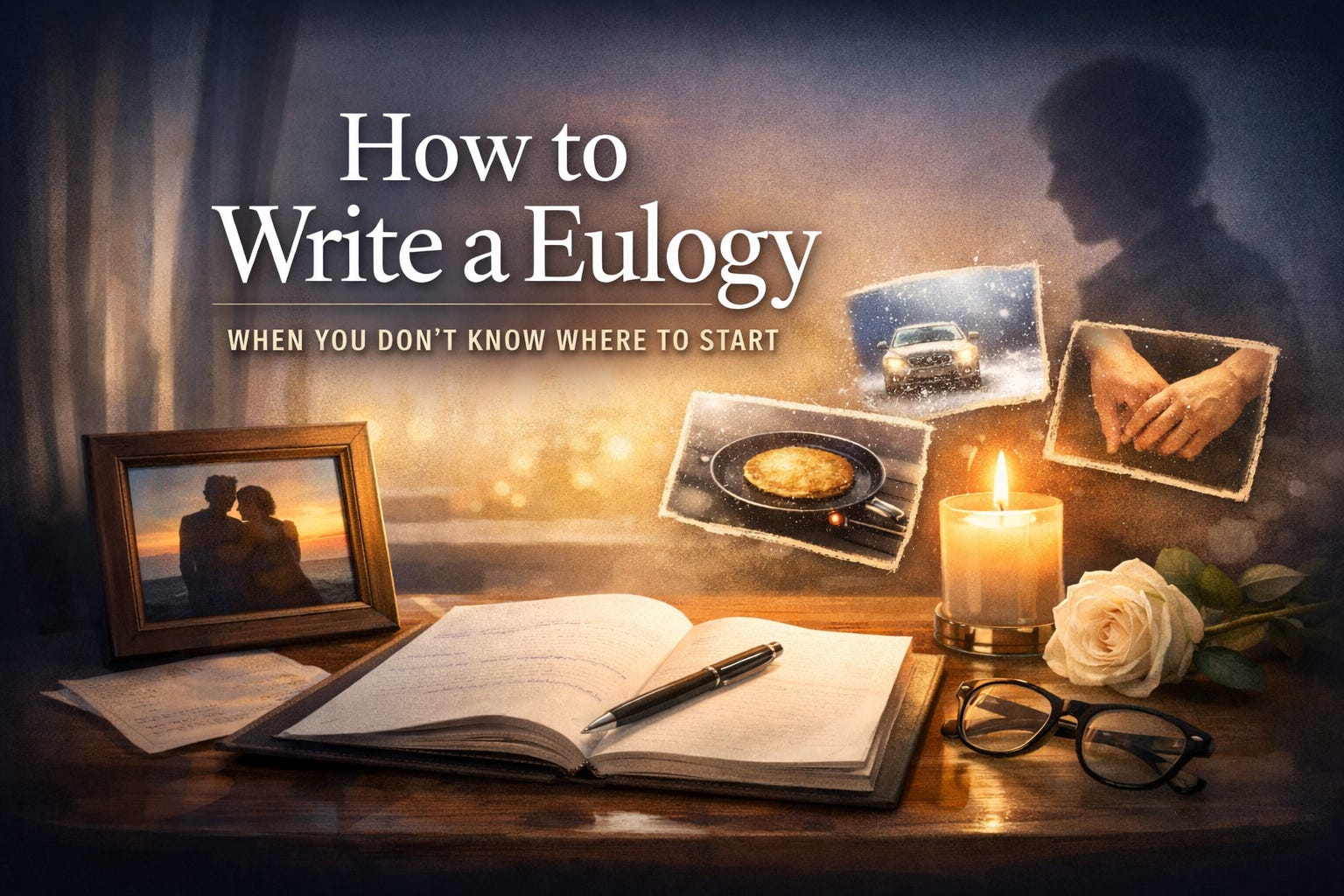
Start With This Truth
You do not need to be a writer to give a good eulogy.
The best eulogies are not literary masterpieces. They are specific, honest, and personal. A three-minute talk where you tell one real story about someone is infinitely better than a ten-minute polished speech full of generic praise.
Nobody at that funeral wants to hear that your father was “a wonderful man who touched many lives.” They want to hear about the time he drove three hours in a snowstorm to bring you soup when you had the flu.
They want the specific thing. The real thing.
The Blank Page Problem
Here is why eulogy writing is so hard: you are being asked to summarize an entire human being while your brain is fogged by grief. The scope is paralyzing. Where do you even start?
The answer is: do not try to summarize them. Pick one thread and pull it.
If you try to cover everything -- their career, their personality, their achievements, their relationships, their legacy -- you will produce something that sounds like a Wikipedia article. Instead, pick the one thing that was most essentially them, and build outward from there.
A Framework That Works
I have seen hundreds of eulogies come through our generator at this point. The ones that work best follow a pattern. Here it is:
Part 1: The Hook (30 seconds)
Open with something specific. Not “We are here today to celebrate the life of...” — everyone already knows why they are there.
Instead, this is a better approach:
A thing they always said (”My mom’s answer to every problem was ‘well, let’s just figure it out then’”)
A quick scene (”The last time I saw my dad truly happy, he was burning pancakes on a Sunday morning and singing off-key”)
A direct statement (”My brother was the funniest person I have ever known, and I am not exaggerating”)
You have 30 seconds before the room decides whether to lean in or zone out. Give them something real.
Part 2: The Portrait (2-3 minutes)
This is the body. Tell 2-3 stories that show who this person was. Not accomplishments. Not a resume. Stories.
The stories should be:
Specific — Names, places, details. “One Tuesday in March” is better than “one time.”
Sensory — What did they look like doing this? What did the room smell like? What were they wearing?
Revealing — Each story should show a quality, not just narrate an event. The pancake story is not about pancakes. It is about joy.
Connect the stories. They should feel like facets of the same person, not random anecdotes.
Part 3: The Gift (30 seconds)
End with what they gave you. What they gave the room. What the world lost.
This is not the place for platitudes. This is the place for the one sentence you have been carrying in your chest since they died. Say that thing.
“She made everyone feel like the most important person in the room, and I do not know how to walk into a room without her.”
That kind of thing. The true thing.
How Long Should a Eulogy Be?
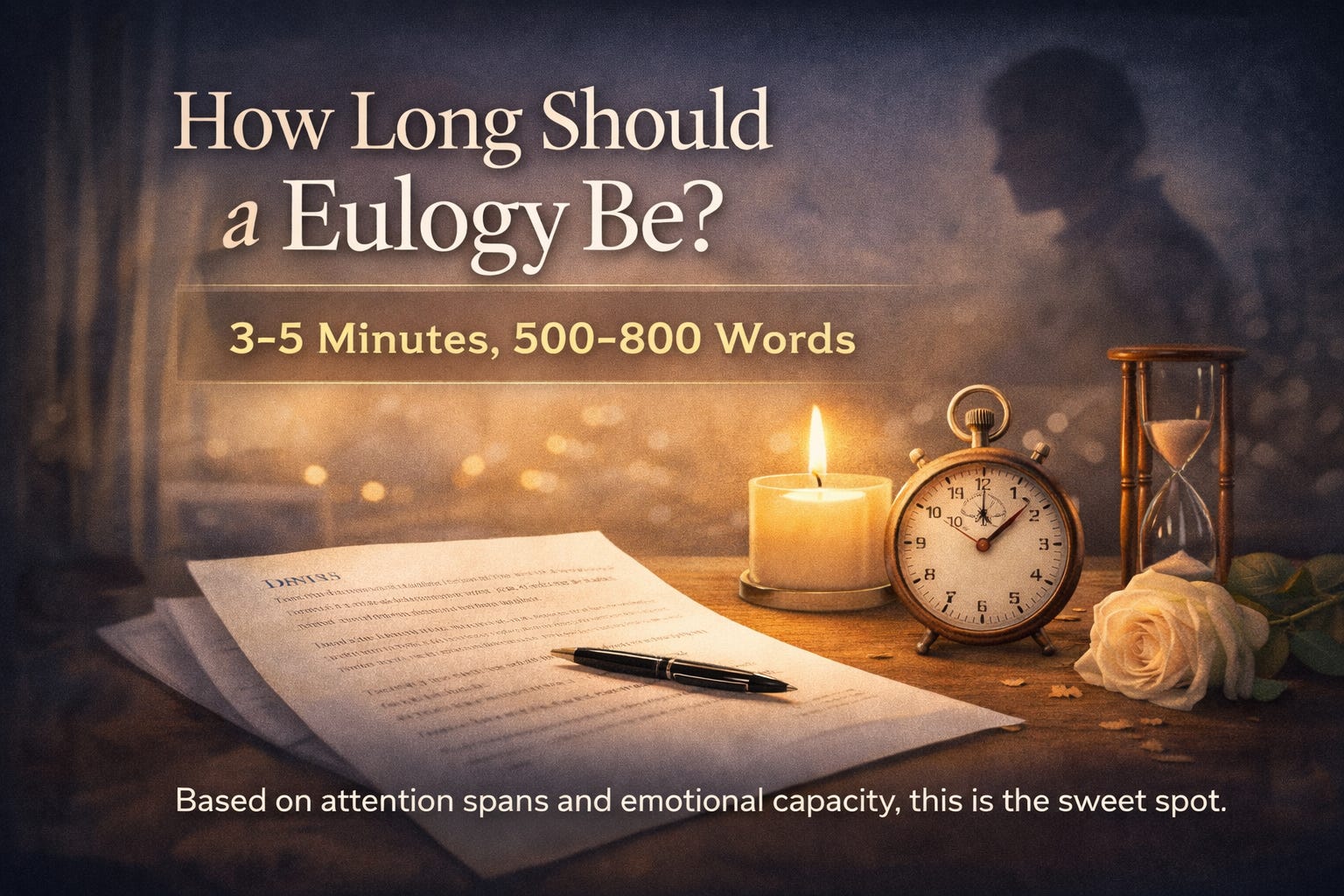
From our experience — and from what seems to be generally accepted as a good range of length and time — 3-5 minutes. 500-800 words.
This is not a rule. It is a sweet spot based on attention spans, emotional capacity, and the fact that there are usually other speakers. If you go under 3 minutes, it can feel rushed. Over 7 minutes and you are asking a grieving room to hold focus for longer than most of them can.
Time yourself reading it aloud. Read slower than you think you should -- grief has a way of making people rush.
Common Mistakes
A few common issues that can get in the way of what you’re trying to share:
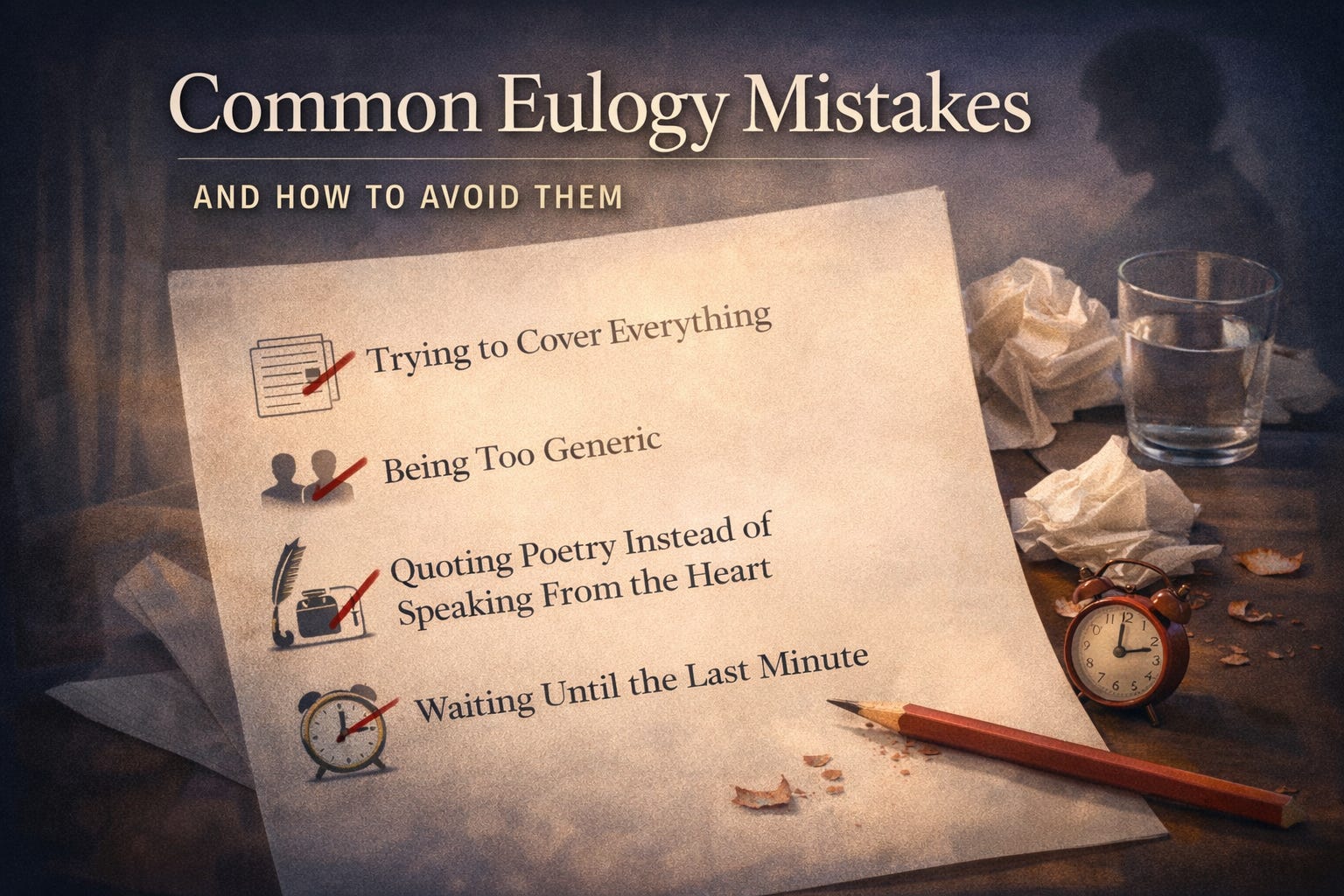
Trying to be comprehensive. You cannot cover their entire life. Do not try. Pick the thread that matters most.
Being too generic. “He was a loving father and husband” could apply to millions of people. What was specific about how he loved?
Apologizing. Do not open with “I am not a great public speaker” or “I do not know if I can get through this.” You will get through it. The room is on your side.
Quoting poetry or famous people when your own words would be better. Shakespeare did not know your grandmother. You did.
Waiting until the last minute. If you can, write a draft 2-3 days before. Sleep on it. Read it again. Edit. The version you write at 2am the night before the funeral is never as good as the version you had time to sit with.
I think the most important thing to remember is that everyone is there for the same reason and they support you doing this (so that they do not have to).
What If You Cry?
You probably will. That is fine. Everyone expects it. Nobody judges it.
Pause. Breathe. Take a sip of water. Continue.
If you cannot continue, it is okay to hand the paper to someone else and let them finish reading it for you. This is not a failure. This is a human being having a human moment at a funeral. It is the most appropriate response possible.
Bring a printed copy. Do not read from your phone -- your hands will shake and you will lose your place. Paper is more forgiving.
The Shortcut
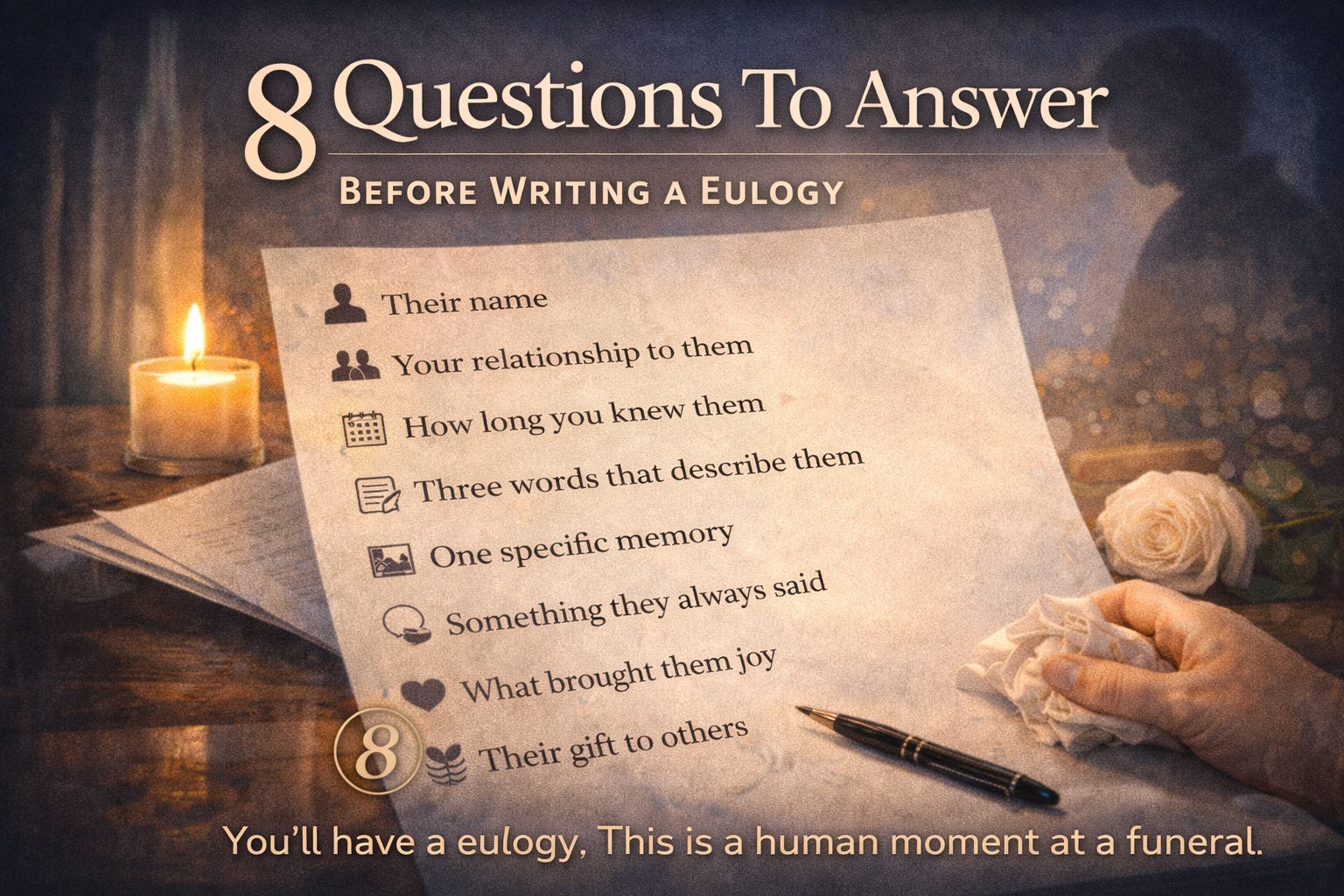
If the blank page is still winning and you need something now, here is the fastest path I know: Answer these 8 questions about the person:
Their name
Your relationship to them
How long you knew them
Three words that describe them
One specific memory
Something they always said
What brought them joy
Their gift to others
Write one paragraph for each answer. You now have a eulogy.
Or use our Free Eulogy Generator — it takes those same 8 questions and builds a structured, editable eulogy in about 5 minutes. You can generate in 4 different tones (reflective, celebratory, formal, personal) and edit the result with a full rich-text editor.
I built it because I believe nobody should have to fight a blank page while they are grieving. The blank page can wait. The grief cannot.
One More Thing
If you are reading this and you are not currently grieving — if you found this article because you are curious, or planning ahead, or just thinking about mortality — consider writing something now.
I know, that might feel super strange but I’ve found that after being in this industry “of death” that encountering it earlier and more often can profoundly help when these do inevitably arise.
It’s not that you have to become comfortable with it; but, you can be more prepared.
There’s a “strategic” reason as well. For instance, write the eulogy for your parent while they are still alive. Not because you are morbid. Because right now you can think clearly, you can call them and ask what their favorite memory is, you can take your time and get the words right.
The version you write today, with a clear head and a full heart, will always be better than the version you write through tears at 2am.
That is the whole idea behind DeathNote. Prepare while you can. Deliver when it matters.
— 8