

Hey folks!
When we built the eulogy generator at DeathNote, one of the earliest design decisions was tone selection. Not as an afterthought or a dropdown menu. As a core feature.
Because a eulogy for a grandmother at a traditional church service is a fundamentally different piece of writing than a eulogy for a best friend at a backyard memorial. Same love. Same loss. Completely different voice.
This post breaks down the 4 tones we offer, when to use each one, and how the same set of memories produces radically different speeches.
Why Tone Matters More Than Words
Most eulogy advice focuses on content: what stories to tell, what memories to share, what structure to use. That matters. But tone is the thing that determines whether the room feels the eulogy or just hears it.
Tone is the difference between:
“He was a man of quiet strength” (formal).
“Dad never said much, but when he did, you listened” (personal).
“He had this steady calm that made everyone around him feel safe” (reflective).
“He was the rock — and he knew it, and he loved being it” (celebratory).
Same man. Same quality. Four completely different emotional registers. So, let’s take a look at what those 4 tones are and an overview of how we designed our tones to carefully capture the right mood.
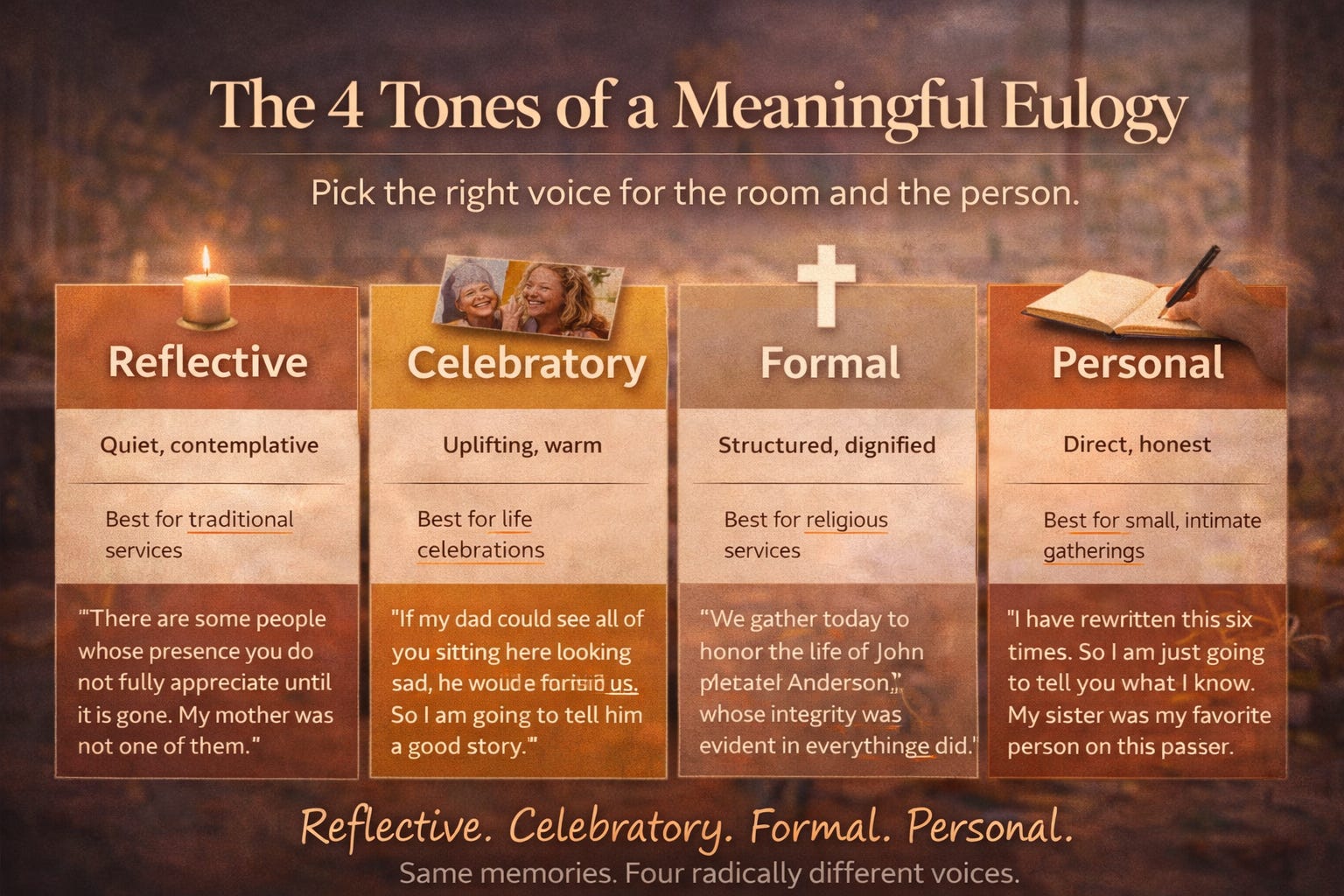
Reflective Tone
Voice: Quiet, contemplative, measured. Pauses between thoughts. Draws the room inward.
Best for: Traditional services. When the loss is raw. When the person was introspective themselves. When you want the room to sit with the weight of the absence.
Characteristics:
Longer sentences with deliberate rhythm.
Present-tense reflections (”I still hear her voice when...”).
Emphasis on meaning over events.
Comfortable with silence and space.
Example opening:
There are some people whose presence you do not fully appreciate until it is gone. My mother was not one of them. I appreciated her every single day. I just did not know how to say it loudly enough.
When to avoid: If the person was loud, funny, larger-than-life. A reflective tone for someone who was the life of every party can feel like a mismatch.
Celebratory Tone
Voice: Warm, uplifting, sometimes funny. Focused on the life that was lived, not the loss. Gives the room permission to smile.
Best for: Memorials and celebrations of life. When the person would have hated a somber affair. When the family wants to remember joy. When there are kids in the room.
Characteristics:
Shorter, punchier sentences
Humor used with care (laughing with, never at)
Stories focused on vitality and joy
Forward-looking: what they would want for us now
Energy that lifts the room rather than settling it
Example opening:
If my dad could see all of you sitting here looking sad, he would be furious. He would tell you to knock it off, go get a beer, and tell him a good story. So that is exactly what I am going to do.
When to avoid: When the death was sudden or traumatic and the room is not ready for lightness. Read the family’s temperature first.
Formal Tone
Voice: Structured, dignified, traditional. The voice you hear at state funerals and religious services. Carries weight through cadence and restraint.
Best for: Religious ceremonies. Military services. Large funerals with diverse attendees who may not know each other. When the family expects tradition.
Characteristics:
Structured paragraphs with clear transitions
Third-person references common (”John was a man who...”)
Measured language, no slang or casual phrasing
Acknowledgment of the setting and the community
May incorporate religious or philosophical references
Example opening:
We gather today to honor the life of John Michael Anderson -- a devoted husband of forty-three years, a father who shaped three lives with patience and purpose, and a man whose integrity was evident in everything he did.
When to avoid: Small, intimate gatherings where this register feels stiff. If the person was informal and would have rolled their eyes at formality.
Personal Tone
Voice: Direct, honest, conversational. Speaking to the room the way you would speak to a friend. The most emotionally naked of the four tones.
Best for: Small gatherings. When you were very close to the person. When authenticity matters more than polish. When you want the room to feel like they are hearing a real human, not a performance.
Characteristics:
First-person throughout (”I remember,” “she told me,” “we used to”)
Sentence fragments and natural speech patterns
Emotional honesty, including difficult feelings
Specific, unpolished details (the kind you would not put in a formal speech)
Feels like a conversation, not a presentation
Example opening:
I have rewritten this six times. Every version sounded like someone else talking. So I am just going to tell you what I know. My sister was my favorite person on this planet, and I do not know how to be here without her.
When to avoid: Very large or formal settings where this level of intimacy might not land. If you are speaking on behalf of an organization rather than as an individual.
The Same Memory, 4 Ways
Here is how tone transforms identical content.
The memory: She made the best chocolate chip cookies and would always have a batch ready when you visited.
Here’s how our tool would present them based on your desired tone:
Reflective Tone:
There was a ritual to visiting her house. Before you even reached the door, you could smell the chocolate chips. She never asked if you wanted cookies. She simply knew that the act of baking them was its own kind of love language, spoken without words, understood completely.
Celebratory Tone:
You could not walk into that woman’s house without gaining three pounds. Chocolate chip cookies. Every single time. Fresh out of the oven, like she had some kind of sensor that detected you pulling into the driveway. It was her superpower and she wielded it shamelessly.
Formal Tone:
Among her many gifts was a remarkable talent for making others feel welcome. Visitors to her home were invariably greeted with freshly baked chocolate chip cookies — a small gesture that spoke to her deep and consistent generosity of spirit.
Personal Tone:
She always had cookies ready. Always. I do not know how she timed it. I would show up unannounced and there they were, still warm. I asked her once how she always knew. She said she did not know. She just always had a batch going because you never know who might need one. That was my mom.
Same cookies. Same love. Four completely different emotional experiences.
How to Choose
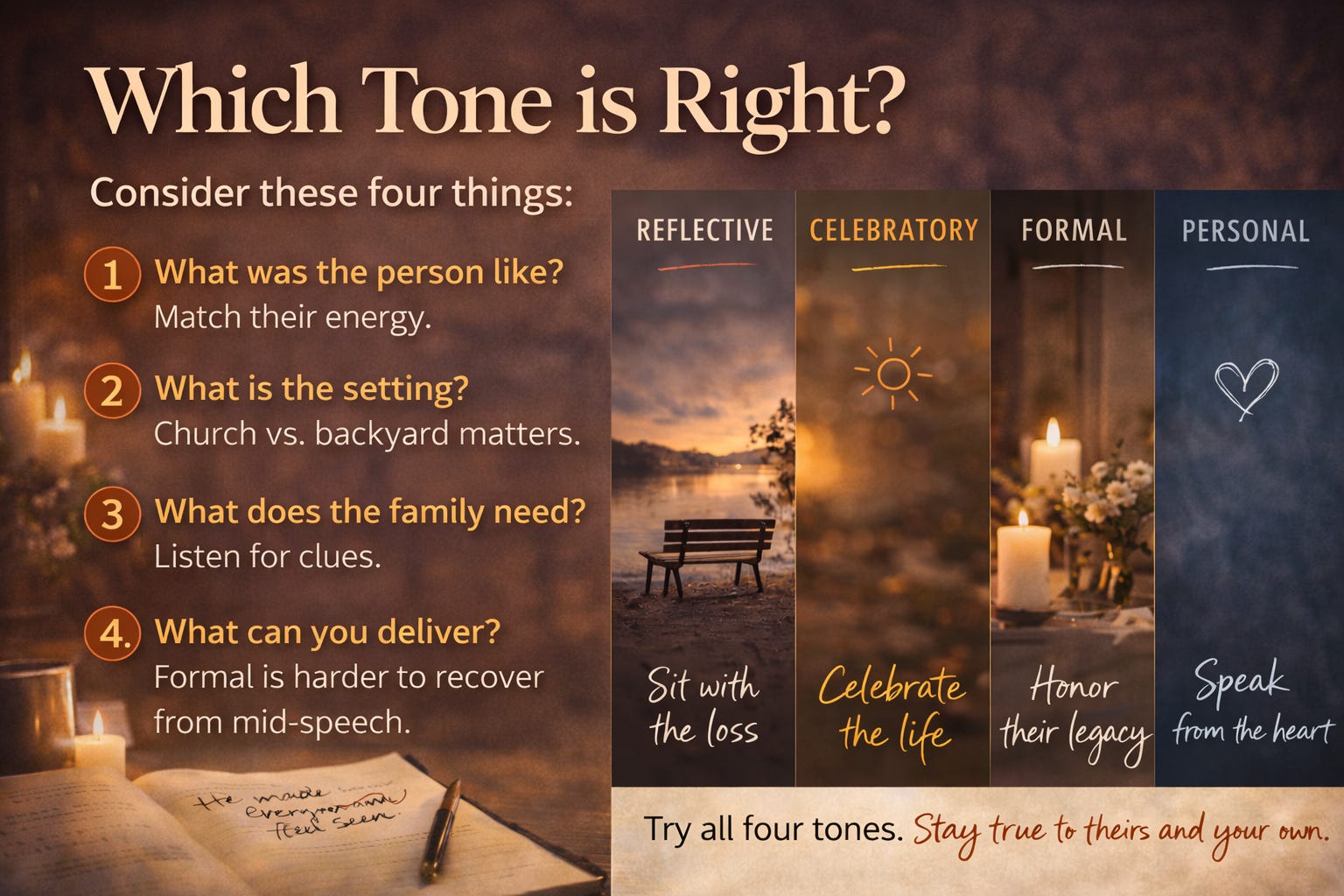
Ask yourself:
What was the person like? Match their energy.
What is the setting? Church vs. backyard matters.
What does the family need? Sometimes they tell you. Listen.
What can you deliver? If you will cry (and you might), personal and celebratory are easier to recover from mid-speech than formal.
Here’s a hot tip that we’ve seen our users try: Generate in all 4 tones and read them aloud. Your gut will tell you which one is right. You will feel it in your chest.
The right tone is the one that sounds like truth. The wrong tone is the one that sounds like performance. Trust your gut.
— 8