

Hey folks,
DeathNote started with a heavy promise: Write the words you do not want lost, set a check-in, and make sure the right people receive them if you are no longer here.
I still believe in that promise. It is the reason the product exists. It’s part of the core.
But the product has been teaching me something uncomfortable and useful. The part people reach for first is not the long-term legacy system. It is the eulogy builder.
That was supposed to be a doorway. But now it’s become the room; a big one.
What We’ve Changed
The original DeathNote thesis was about preparation. You write before the crisis. You decide what matters. You name the people who should receive your words. The product protects that intent until it needs to be delivered.
That is meaningful, but it asks a lot from a person on an ordinary day. And it’s hard to get in the right mind for writing about your inevitable death.
In contrast, the eulogy moment asks for something different. It shows up when the need is already real. Someone has died. The service is soon. A child, parent, sibling, spouse, or friend is staring at a blank page and trying to turn a whole life into a few honest minutes.
That person is not browsing productivity software. They are not comparing legacy-planning tools. They are trying to say the right thing without sounding generic, cold, or performative.
That is a much sharper product moment. Something we started to take notice.
The Data is Not Subtle
A recent growth report made the pattern hard to ignore.
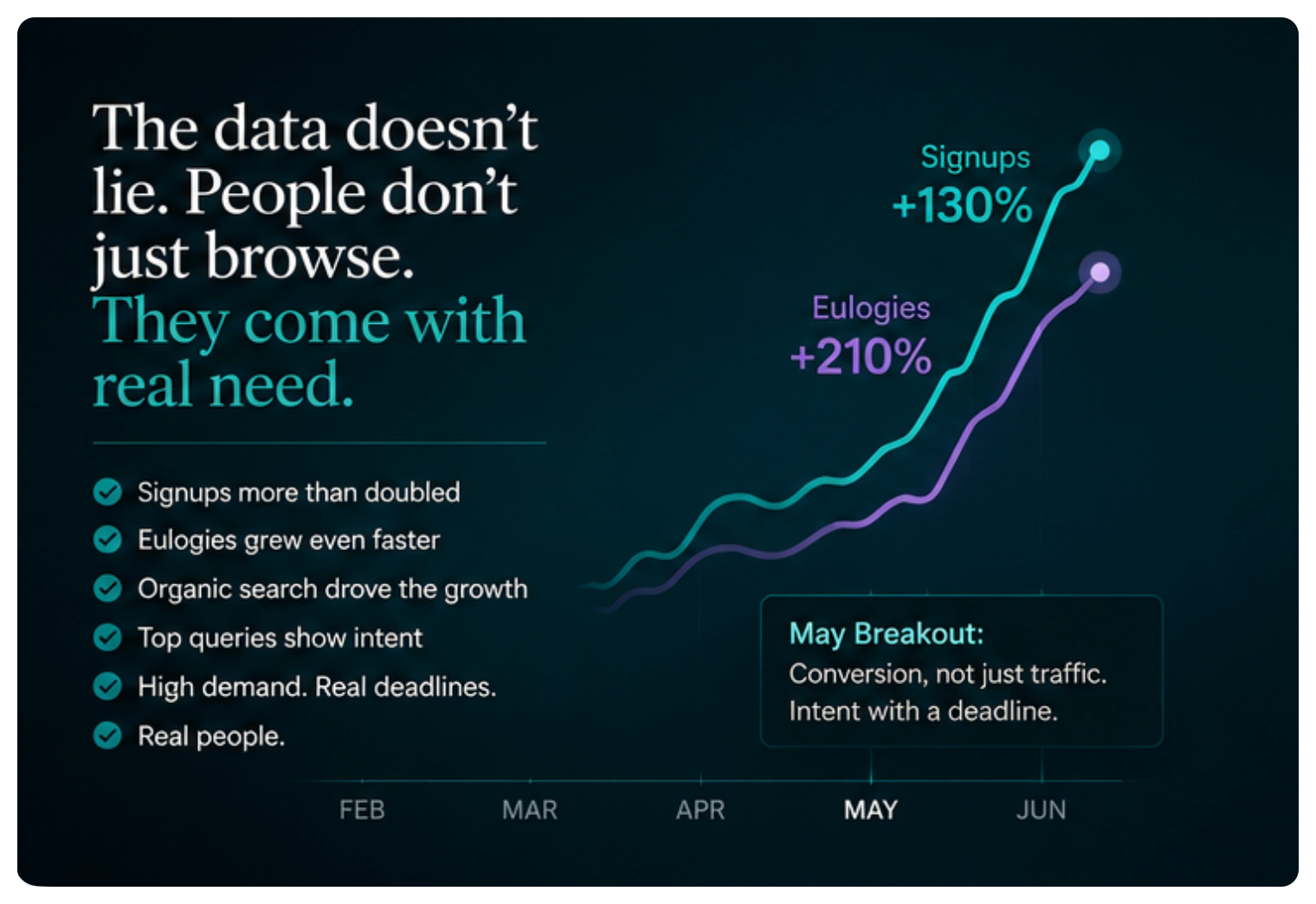
As we dug into the analytics we saw nothing but very positive growth. In May, we had a breakout month with triple-digit sign-ups! A first for us!
But, this is not a generic traffic spike. It was a conversion story. Total site traffic was flat-to-down, but signups more than doubled, and eulogies grew even faster.
Our organic search was doing the work and the eulogy generator became a top entry point, and the strongest query cluster was exactly what you would expect:
Free eulogy generator
Free AI eulogy generator
Eulogy generator
AI eulogy generator free
AI funeral speech
That is not vague interest. That is intent with a deadline.
The relationship data points the same direction. A large share of people are writing for a parent or a child. The tone data points there too. People overwhelmingly choose personal and warm over formal. They do not want a funeral template. They want help sounding like themselves at a moment when their brain is overloaded.
That matters strategically because it tells me the product is not winning through novelty. It is winning because it is present at the exact moment someone needs the thing. So, we started investing more of our time into thinking how we could add even more value to our users without fundamentally changing our vision for the platform.
Why The Change of Focus Makes Business Sense
A good business is not just a product people admire. It is a product people find, understand, trust, and use at the moment of need.
Eulogies have all four.
They have clear demand. People search for eulogy help every day, in plain language, often with the word free because they are not in a shopping mood. They are in a crisis.
They have high intent. Someone who needs a eulogy is not casually exploring. They have a real event, a real deadline, and a real emotional cost if the output is bad.
They have natural distribution. Every eulogy is connected to a family, a service, a printed program, a speech, a memorial page, and the people who hear it. This is not a spammy viral loop. It is human distribution around a meaningful artifact.
They have international reach. Grief is local, cultural, and language-specific, but the need is universal. The multilingual pages are already showing that people find this product from many countries and many search patterns.
They have simple monetization. The right model is not a subscription wall around grief. The right model is generous free usage, then paid credits when someone needs more help, more drafts, more refinement, or a better final artifact.
That is why the eulogy pivot is not a retreat from the original company. It is a sharper route into it.
Why It Also Makes Product Sense
The legacy-message product is emotionally important, but it has a timing problem. It asks people to imagine a future loss.
The eulogy product has the opposite problem. The loss has already happened. The urgency is present. The user knows exactly why they are there.
That makes the product easier to improve because the job is concrete:
Help me start
Help me sound like myself
Help me include the right stories
Help me make this readable out loud
Help me refine it without losing the emotional core
Help me print, copy, save, and return to it safely
Those are not abstract growth ideas. They are product requirements hiding inside grief. And we need to help make that process as easy and frictionless as possible.

The Deeper Strategic Point
The old framing was:
DeathNote helps your words survive you.
That is still true.
The sharper framing is:
DeathNote helps the right words show up when death makes words hard.
That includes legacy messages. It includes check-ins. It includes delivery. But it starts with the most urgent writing moment most people will ever face.
The business lesson is simple: Start where the pain is loudest.
The human lesson is better: People do not need another AI toy. They need something that helps them do a hard human task with more care than they could manage alone in that moment.
If the product can do that, it earns the right to help with what comes next. That’s why DeathNote is treating eulogies as a first-class product surface, not just a side feature (which is honestly how it started).
So now users can have better generation, but not just longer output. It means better questions, better memory of the user’s work, better refinement, better print and reading flows, better multilingual support, and better analytics around what actually helps someone finish.
It also means being careful with monetization. The free tier has to remain useful. Paid credits should feel like buying extra help, not paying a toll at the worst possible time.
And eventually, the bridge back to the original product should feel natural:
You wrote something beautiful about someone you lost. Would you like to save words for the people who will one day miss you?
That is the whole company in one sentence.
Most people will not wake up tomorrow and decide to configure a digital legacy plan.
But many people will wake up tomorrow needing to write a eulogy.
Some will be adult children trying to honor a parent. Some will be parents facing the most unfair speech imaginable. Some will be friends asked to speak because they knew the person in a way nobody else did.
If DeathNote can meet them there, it can help more people immediately than the original product could on its own.
That is the pivot. That is the plan. It always has been.
We’re in the business of death preparation, before and after. We’ll meet you where you are and we’ll help you if we can.
— 8