

Hey folks!
We’ve got a free, new tool for everyone to use for even more of those difficult moments. It will help you write a concise but impactful obituary for your loved ones and those that have passed.
You enter the facts you know, choose a tone, and get a careful draft you can edit, copy, print, and refine. It is not a memorial page. It is not a publishing platform. It is not pretending to be the family.
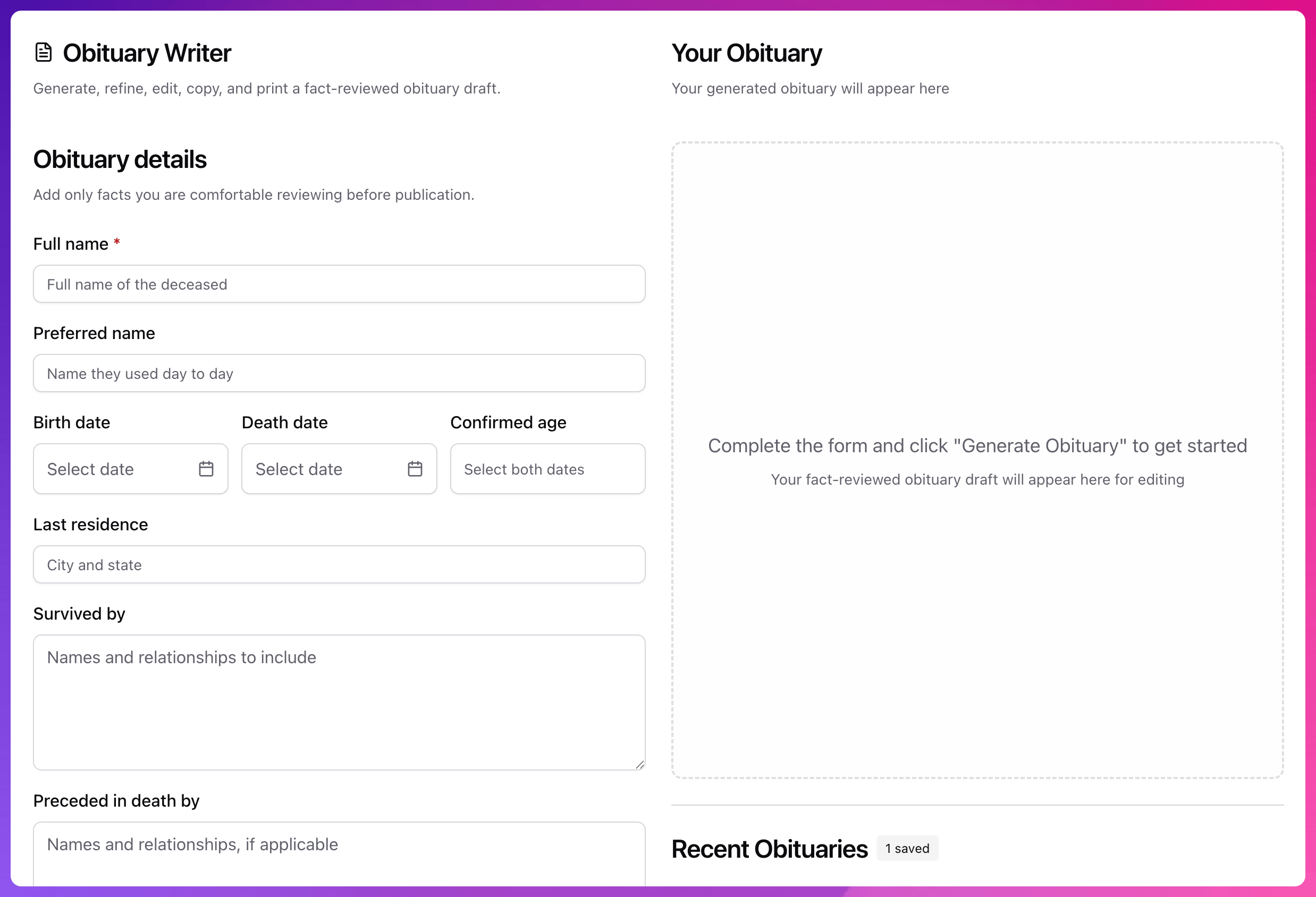
It is a writing tool for one of the most compressed moments after someone dies: somebody has to announce the death, summarize a life, name the family, and get the service details right.
That sounds simple until you are the person staring at the blank page.
What We Built
The eulogy builder taught us that DeathNote works best when it meets people at a real writing moment, not an abstract planning moment.
A eulogy is spoken. It is personal, memory-driven, and shaped by the person who has to stand up in a room and say it out loud.
An obituary is different.
It is factual. It is public. It is often copied into a funeral home website, a newspaper form, a printed program, a family email, or a social post. It needs names, dates, family relationships, service details, donation information, and enough life story to feel like a person was actually here.
That difference matters. I did not want to ship a eulogy prompt with the labels changed.
The obituary writer needed stricter rules. So we took what we know worked and reformatted into a new frame.
The Product and Value Bar is Different
A good eulogy can be emotionally true even if it leaves out a date.
A good obituary cannot casually invent one.
That became the center of the build. The obituary writer is designed around fact discipline:
It uses only the facts the user supplies.
It does not invent a cause or manner of death.
It does not add phrases like peacefully or surrounded by loved ones unless the user actually says that.
It keeps service and donation wording close to what the family entered.
It flags likely omissions so the family knows what to review before sharing.
The output is still only a draft. That is not legal fine print. It is the honest product stance but an amazing foundation to start.
An obituary is too important to be treated as final because a model wrote it. The family has to review it. Names have to be checked. Dates have to be checked. Service details have to be final before they are published.
The tool should lower the burden, not take over the responsibility.
We Did Our Homework (on the Market)
Obituary help is not a strange category.
Legacy has templates and an online publishing path. Ever Loved has templates and AI-assisted writing. Funeral homes are increasingly offering AI obituary help inside their planning workflows. Funeral software companies are building AI obituary assistants for directors because directors spend real time collecting facts and turning them into a public notice.
That tells us two things.
First, the need is real. Families already ask for help because the writing job arrives during logistics, shock, and grief.
Second, the competitive bar is higher than it was for eulogies. Obituaries are a more mature search and death-care category. DeathNote is not entering empty space.
So the product has to be sharper about what it is.
I do not think the winning angle is AI writes a beautiful tribute in seconds. That is too easy to overpromise.
The better angle is: AI helps you turn verified facts into a respectful obituary draft you can control.
That is less flashy. It is also more true.
Why it Makes Good Business Sense
The eulogy builder proved that acute grief search has real intent. People search for help when the job is unavoidable and time-sensitive.
Obituaries sit next to that same moment, but with a slightly different intent.
The eulogy user is thinking, What do I say?
The obituary user is thinking, What do I include, and how do I say it correctly?
That opens a real product surface:
A free draft for the immediate need
Paid extra actions when someone wants more refinement
Future designed PDF or newspaper-ready formatting
Future publishing handoff, if we can do it without pretending to be a funeral home or a newspaper
Future flowers or memorial donation handoffs where the intent actually fits
And to be honest, we’re going to investigate all of these opportunities to make our platform even better. But, the free part matters. Families should not feel trapped into paying just to get a basic announcement drafted.
The paid part has to be additive: More revisions, better formatting, export, packaging, and handoff. Charge for the finished artifact and the convenience around it, not for access to words during a hard week.
That is the same lesson the eulogy product keeps teaching me.
Why This Makes Sense
The obituary writer extends DeathNote without changing the promise.
DeathNote is not just about messages after death. It is about helping the right words show up when death makes words hard.
Sometimes those words are private.
Sometimes they are spoken.
Sometimes they are public.
An obituary is the public version. It tells a community that someone died. It preserves the basic record. It tells people where to gather, where to send flowers, where to donate, and who is grieving.
That is a different job from a eulogy, but it belongs in the same family of tools.
And all of this matters a lot to us because we know that people do not need an AI tool that acts emotional. They need a tool that helps them do the next hard thing with less friction and more care.
For eulogies, that means helping someone stand up and speak.
For obituaries, it means helping someone announce a death accurately, respectfully, and in time.
That is a small sentence with a lot inside it.
It is worth building well.
— 8