

Hey folks!
Since launching the eulogy generator at DeathNote, hundreds of eulogies have come through the system and we have read more eulogies in the past few months than most funeral directors read in a year.
That is definitely a strange thought! But, patterns have emerged. The eulogies that work share specific traits. The ones that fall flat share different ones. This post is what we’ve learned (and continue to learn) from our community.
No names, no identifying details. Just the patterns.
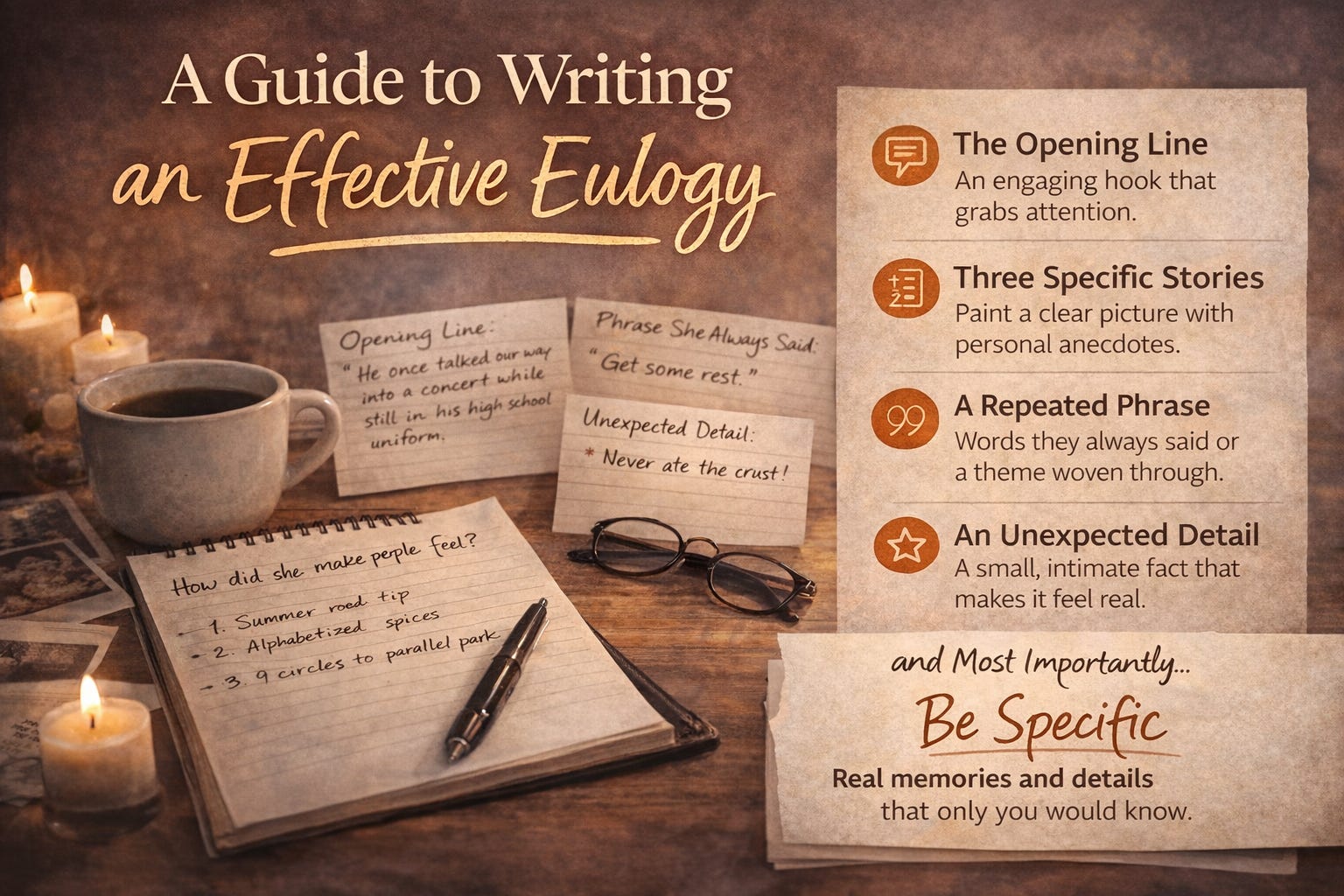
The One Rule
Every great eulogy I have seen follows one rule, whether the speaker knew it or not:
Be specific.
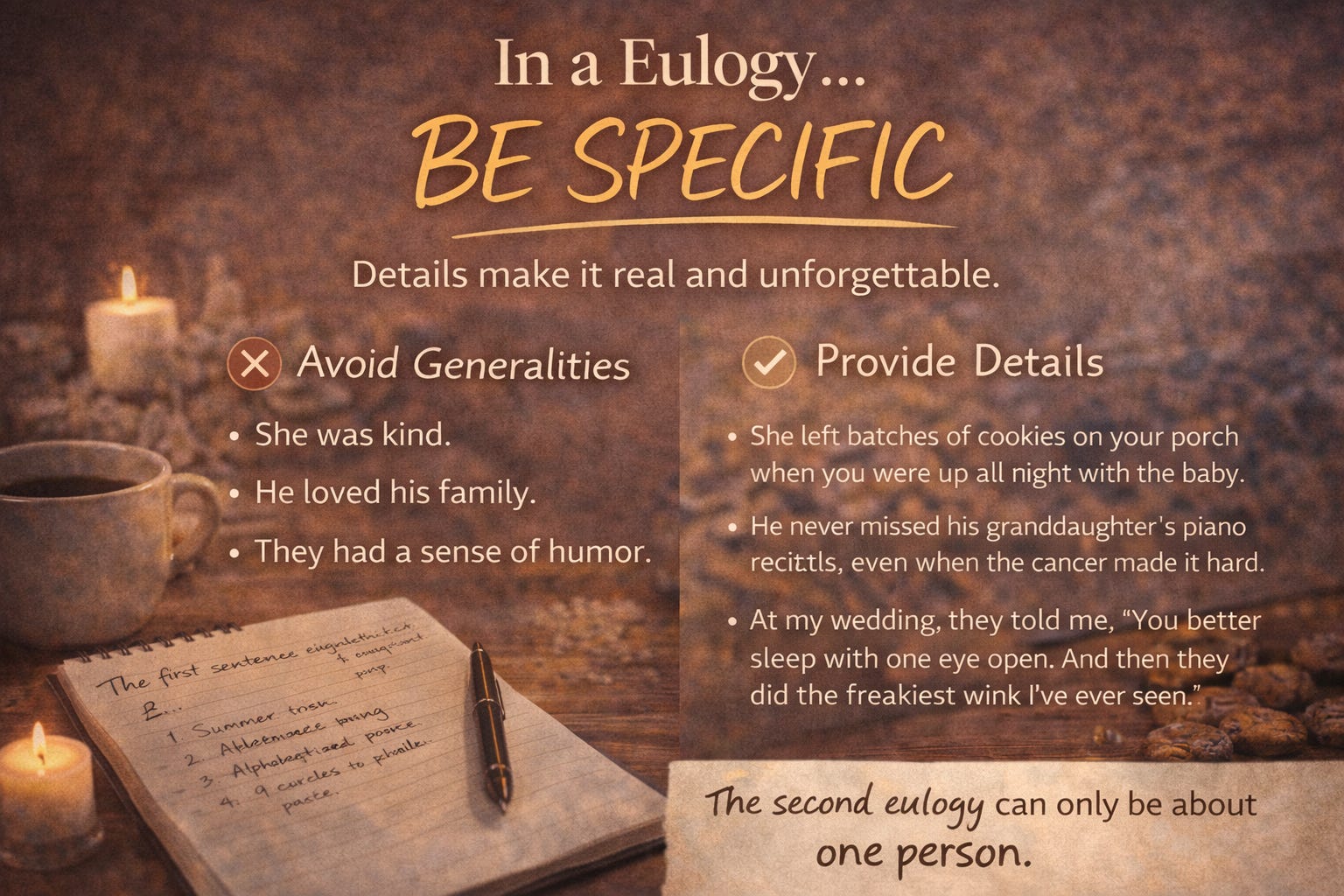
Not “she was kind.” How was she kind? Not “he loved his family.” How did he show it? Not “they had a great sense of humor.” What was the joke? What was the moment?
Specificity is the difference between a eulogy that could be about anyone and a eulogy that could only be about one person. The second kind is the one that makes the room cry.
Pattern 1: The Opening Line
The first sentence determines everything.
Openings that work:
“My brother once convinced an entire restaurant that he was a food critic from the New York Times. He was fourteen.”
“The last thing my grandmother said to me was ‘stop fussing.’ She said it from a hospital bed. She meant it.”
“I have been trying to figure out how to describe my dad to people who never met him. The best I have come up with is: imagine the most patient person you know, then double it.”
Openings that do not work:
“We are gathered here today to celebrate the life of...”
“Webster’s dictionary defines legacy as...”
“I want to start by thanking everyone for being here.”
The first category pulls you in. The second category is throat-clearing. The room is already there. They already know why. Skip to the thing that matters.
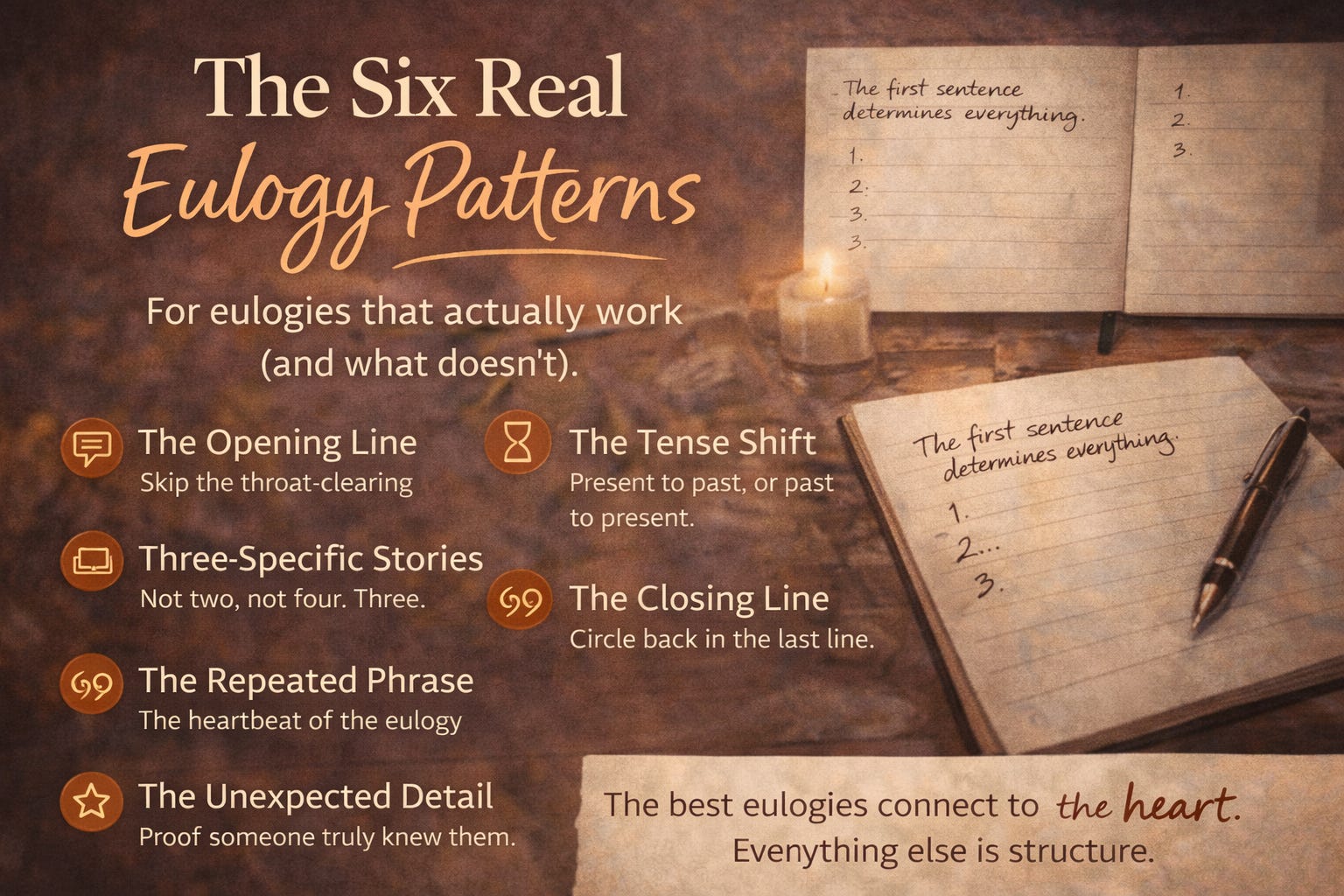
Pattern 2: The Three-Story Structure
The eulogies that feel complete — not too short, not rambling — almost always contain exactly three stories.
Not two (feels thin). Not four (starts to drag). Three.
Why three works:
Story 1 establishes who the person was.
Story 2 deepens the portrait with a different facet.
Story 3 delivers the emotional core — the one that brings it home.
The best eulogies use their three stories to create a triangulation. Each story shows a different side, and together they form a full picture. The audience does not need to be told “she was compassionate and funny and fierce.” They experience it through the stories.
Pattern 3: The Repeated Phrase
The most memorable eulogies have a phrase that recurs. Not artificially inserted. Naturally woven.
“She would say, ‘well, we will figure it out.’ When the car broke down — we will figure it out. When I failed a class -- we will figure it out. When the diagnosis came — we will figure it out.”
The repetition creates rhythm. It gives the eulogy a heartbeat. And when you use the phrase one last time at the end, the room feels it land.
This is often the answer to our question “something they always said.” That phrase becomes the structural spine of the entire eulogy.
Pattern 4: The Unexpected Detail
The detail that makes a eulogy feel real is usually the one you almost did not include.
“He alphabetized his spice rack. Every single spice. When we moved him to the care facility, he alphabetized theirs too. The nurses let him.”
“She could not parallel park. Forty years of driving and she never once parallel parked successfully. She would circle the block nine times looking for a pull-in spot. We all knew. Nobody said anything.”
These details are not important. That is what makes them important. They are the things that only people who really knew someone would know. They are proof of intimacy. They are what makes the room laugh and cry at the same time.
Pattern 5: The Tense Shift
The eulogies that hit hardest often shift tense at a key moment. Present to past. Or past to present.
“My mom makes — made — the best pie crust in three counties.”
That correction. That stumble between makes and made. It is the most honest moment in any eulogy because it reveals the speaker’s reality in real time: the person is gone and the brain has not caught up yet.
You do not need to plan this. If it happens naturally, let it stay. It is not a mistake. It is truth.
Pattern 6: The Closing Line
How you end matters as much as how you begin.
Closings that work:
“I will miss you every day, Dad. But I will figure it out. You taught me how.”
“She is not here. But every time I burn the cookies on purpose because I like them crunchy, she is a little bit here.”
“Rest, brother. You earned it.”
Closings that do not work:
“In conclusion, we will all miss John very much.”
“May he rest in peace.”
(Trailing off with no clear ending)
The best closing lines circle back to something from earlier in the eulogy. The repeated phrase. The opening story. A detail from the middle. This creates closure — the audience feels the speech was crafted, even if you wrote it at 3am.
The Length Sweet Spot
From the data:
Under 400 words: Feels rushed. The room has not settled in yet.
500-800 words: The sweet spot. 3-5 minutes spoken. Long enough to say something real, short enough to hold attention.
Over 1,000 words: Starts to test the room’s emotional bandwidth. You can go long if every word earns its place, but most eulogies have padding that should be cut.
The eulogy generator at DeathNote targets 500-800 words by default. It shows live word count and estimated speaking time so you can calibrate.
The Editing Test
Read your eulogy aloud. If any sentence makes you pause and think “I would never actually say that” — cut it or rewrite it in your own words.
AI-generated eulogies have a tell: they use phrases like “left an indelible mark,” “touched the lives of all who knew them,” and “a life well-lived.” These are the machine equivalent of filler words. They sound polished but they say nothing. Replace them with something specific.
“She left an indelible mark” becomes “She taught me how to tie my shoes, how to change a tire, and how to forgive people who do not deserve it.”
Same sentiment. One is wallpaper. The other is a real person.
Build Your Own
If these patterns resonate and you want to build a eulogy using this framework:
Write your opening line — one specific detail that captures the person
Pick three stories that show different sides of who they were
Find the repeated phrase — something they said, something they did, a quality that ran through everything
Include one unexpected detail that only someone who loved them would know
Close by circling back to where you started
Or use our free AI eulogy generator at to get a structured first draft, then edit using these patterns. 8 questions, 4 tones, full editor. Free.
The best eulogy is the one that sounds like you talking about someone you loved. Everything else is just structure to help you get there.
— 8