

Hey folks!
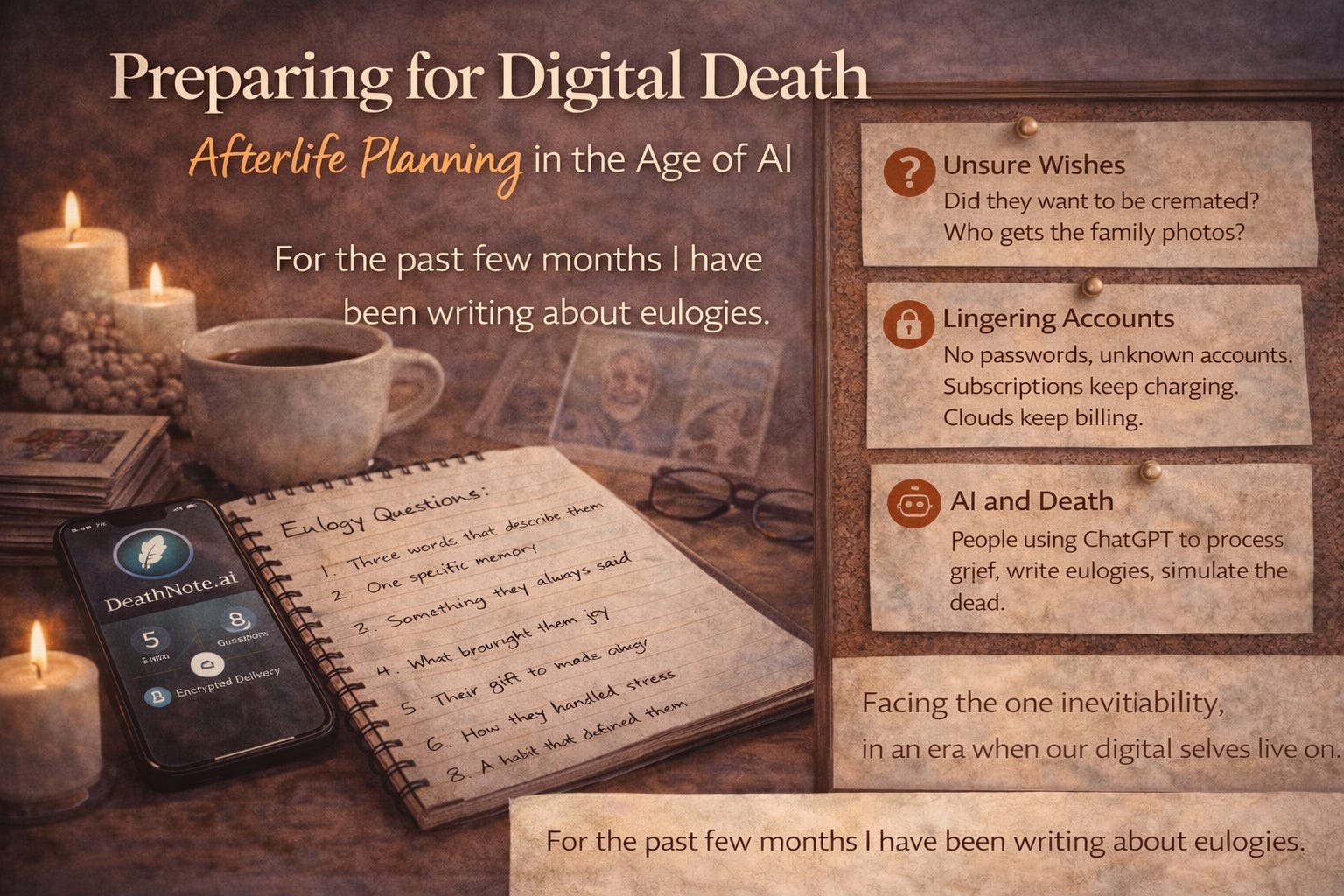
For the past few months I have been writing about eulogies. How to write them. How AI generates them. How tone shapes them. How to give one for someone you barely knew.
This post is about the bigger picture. Because eulogies are one fragment of a much larger question: what happens to our words, our accounts, our digital selves, and our final wishes when we die?
The Eulogy Problem Was a Symptom
I built a free eulogy generator because I saw people struggling with a terrible writing assignment at the worst possible time. That tool works. People use it. It led to our first paying customer.
But the problem the eulogy revealed is bigger than eulogies.
The person writing that eulogy at 2:00am is also the person who:
Does not know the passwords to their parent’s accounts.
Cannot access the deceased’s email to cancel subscriptions.
Has no idea if there was a digital will.
Does not know which photos are backed up where.
Was never told what the person actually wanted said at the funeral.
The eulogy is the urgent thing. But the infrastructure of death preparation is the important thing. And almost nobody has it ready.
The State of Digital Death
Here is what happens when someone dies in 2026:
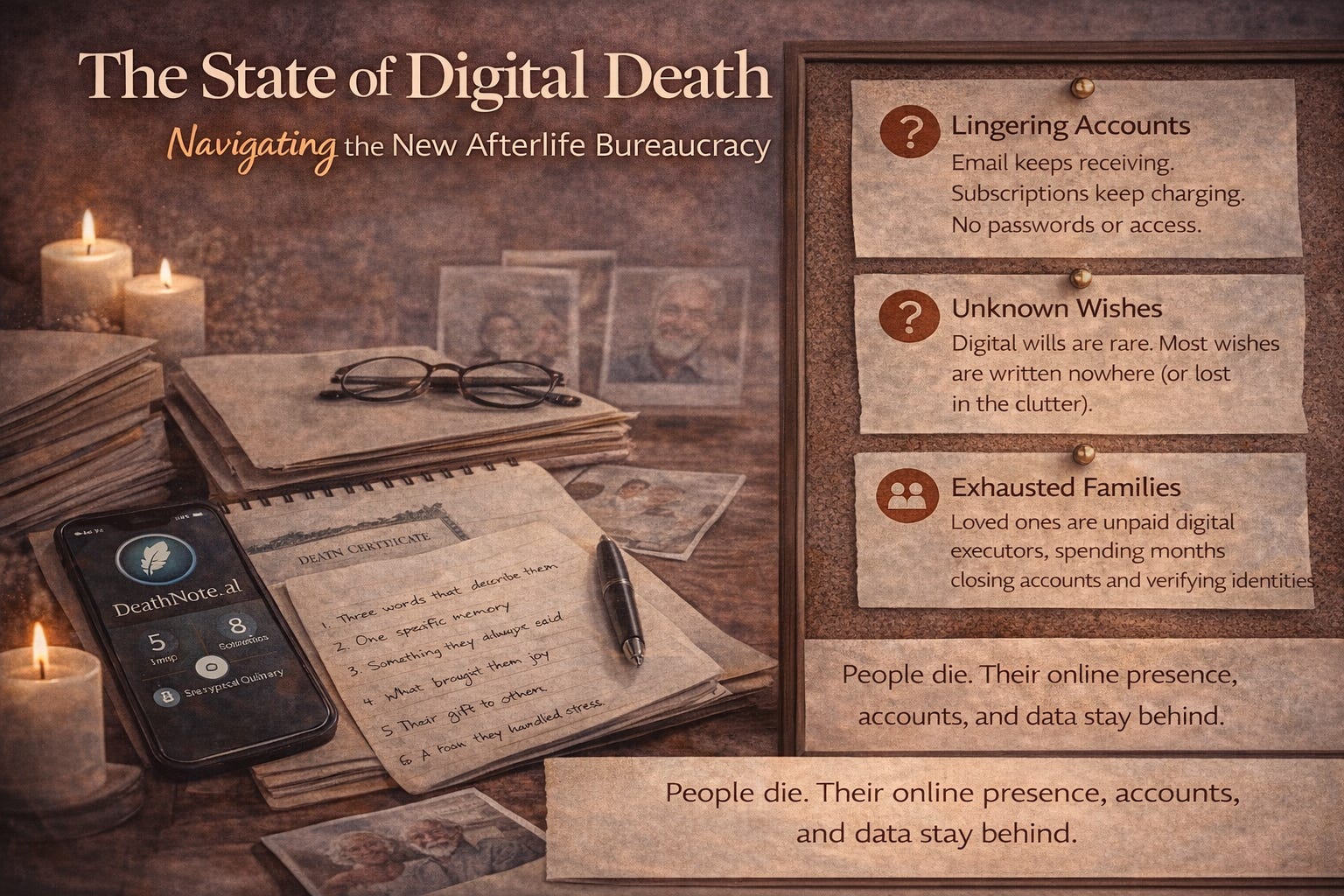
Their accounts persist. Email keeps receiving. Subscriptions keep charging. Social media stays up. Cloud storage keeps billing. No one has the passwords. Some platforms have legacy contact features, most do not, and the ones that do are buried in settings menus nobody configures.
Their wishes are unknown. Did they want to be cremated? Who gets the family photos? Is there a message they wanted delivered? Most people never write this down. The ones who do usually put it in a document nobody can find.
Their digital footprint becomes a burden. The surviving family member becomes an unpaid digital executor, spending weeks or months calling customer service lines, submitting death certificates, trying to close accounts for a person who is not there to verify their identity.
AI is already being used, whether we planned for it or not. People are using ChatGPT to write eulogies, draft obituaries, compose messages to grieving friends, and even simulate conversations with deceased loved ones. This is happening now, unguided, with no quality standards and no ethical framework.
Serious dynamics that deserve serious consideration, right?
What DeathNote Actually Is
The eulogy generator is one tool. The platform that we’ve built is the infrastructure.
Death notes. Write messages to specific people — your children, your partner, your best friend, your lawyer — and encrypt them. They are stored securely and only delivered when you die. Not before.
Proof-of-life verification. The system checks in with you on a schedule you set. If you stop responding, it escalates through multiple confirmation channels. If it confirms you are gone, it initiates delivery.
Encrypted delivery. Your messages are delivered to the people you specified, through the channels you chose. Email delivery with tracking. Read receipts. The system knows whether your final words reached the people they were meant for.
The eulogy generator. The entry point. The tool that brings people in because they need help right now, today, with something urgent and painful. Then they see the rest of the platform and think: I should prepare so my family does not have to go through this.
Simple tools that serve really important needs.
The AI Question
Every few weeks someone asks me: is it weird to use AI to write a eulogy? To write a death note? To compose your final words?
My answer: The AI is not writing your words. It is helping you find them.
When you answer our 8 questions — three words that describe them, one specific memory, something they always said — those are your memories. Your words. Your relationship. The AI structures them. The AI generates a draft. But the raw material is irreplaceably human.
This is the correct use of AI in mortality planning: reduce the friction between your intention and your expression. Make it easier to do the hard thing. Do not replace the human part. Replace the blank page.
The incorrect use — and it exists — is letting AI simulate a dead person. Chatbots that mimic the deceased. AI-generated voice messages from people who never recorded them. That is not legacy planning. That is something else, and I am not building it.
What I Have Learned
Building a death preparation platform teaches you things about people that nothing else does.
People want to prepare. The assumption that “nobody wants to think about death” is wrong. Lots of people want to think about it. They just do not have good tools. When you give them a free eulogy generator, they use it. When you show them they can write death notes to their children, they sign up.
The entry point matters. Nobody wakes up and googles “digital death preparation platform.” They google “free eulogy generator” because someone they love just died. They google “proof of life app” because they are going on a solo backpacking trip. They google “posthumous messages” because they read an article about someone who left one. The entry point is always a specific need. The platform reveals itself from there.
Simple beats comprehensive. Our eulogy generator asks 8 questions. Not 40. Our death notes are plain text with encryption. Not multimedia productions. Our proof-of-life check is a simple verification prompt. Not a biometric scan. The simpler the tool, the more people actually use it.
Death is universal but grief is cultural. This is why we translated the library into 50 languages. It is why the eulogy generator has 4 tones. It is why we do not prescribe how someone should grieve or prepare. We give them tools and let them use them in whatever way makes sense for their family, their culture, their situation.
Where This Goes
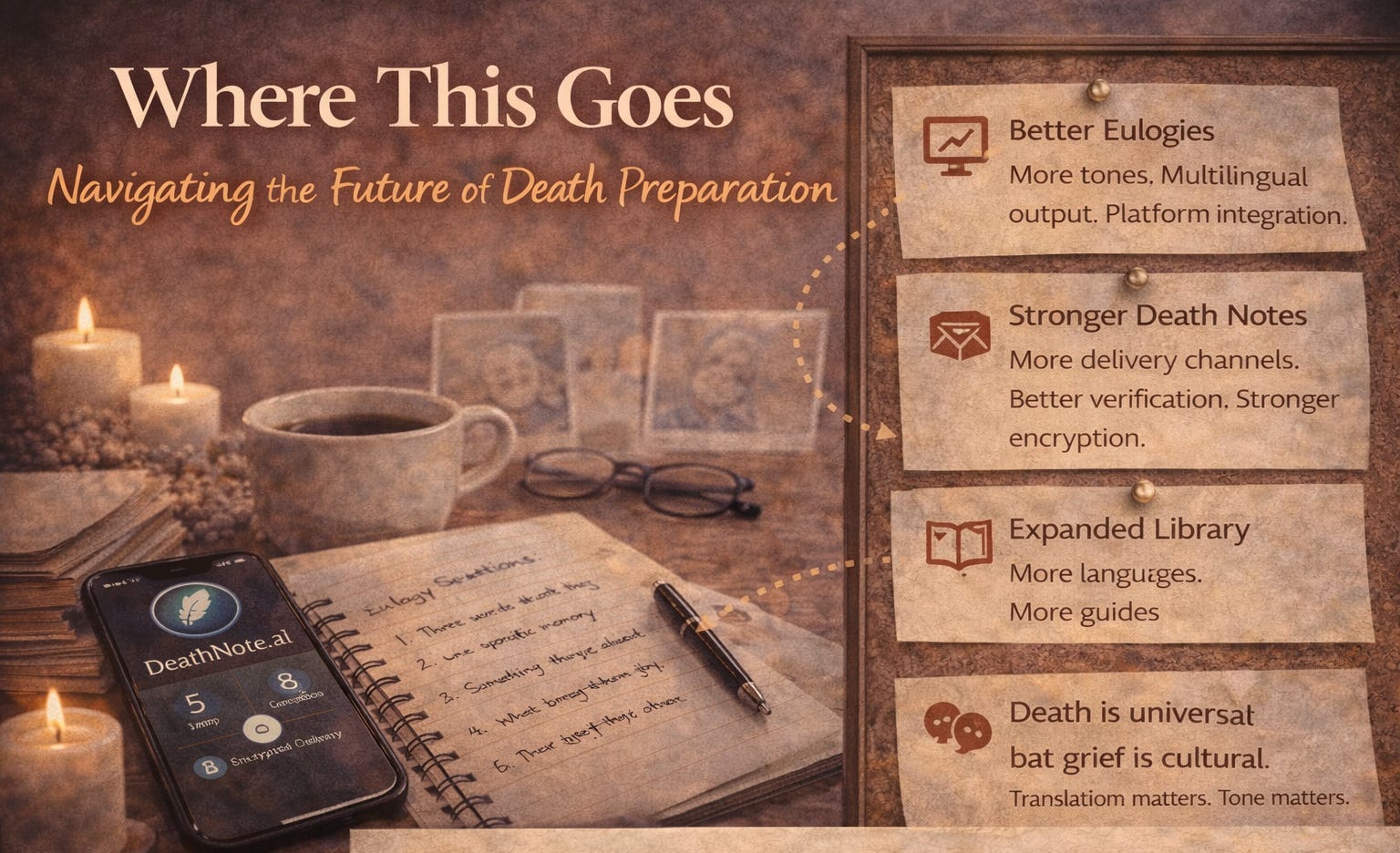
The eulogy generator will keep getting better. More tones. Better output. Multilingual generation. Integration with the rest of the platform so you can save a eulogy to someone’s memorial page.
The death note system will keep getting more durable. More delivery channels. Better verification. Stronger encryption.
The library will keep growing. More languages. More guides. More practical information for people navigating the worst bureaucracy of their lives.
And the platform will keep doing the one thing it was built to do: make it so that when you die, the people you love are not left scrambling. They have your words. They have your wishes. They have a eulogy they can actually deliver.
That is the promise.
— 8