

Hey folks!
This post is for the person who just got asked to speak at a funeral and thought: “Why me? I barely knew them.”
It happens more often than anyone admits.
A coworker dies and you are the one on the team who is best with words. A distant uncle passes and the family looks at you because you are “the one who gives good toasts.” Your neighbor’s funeral needs another speaker and somehow you are it.
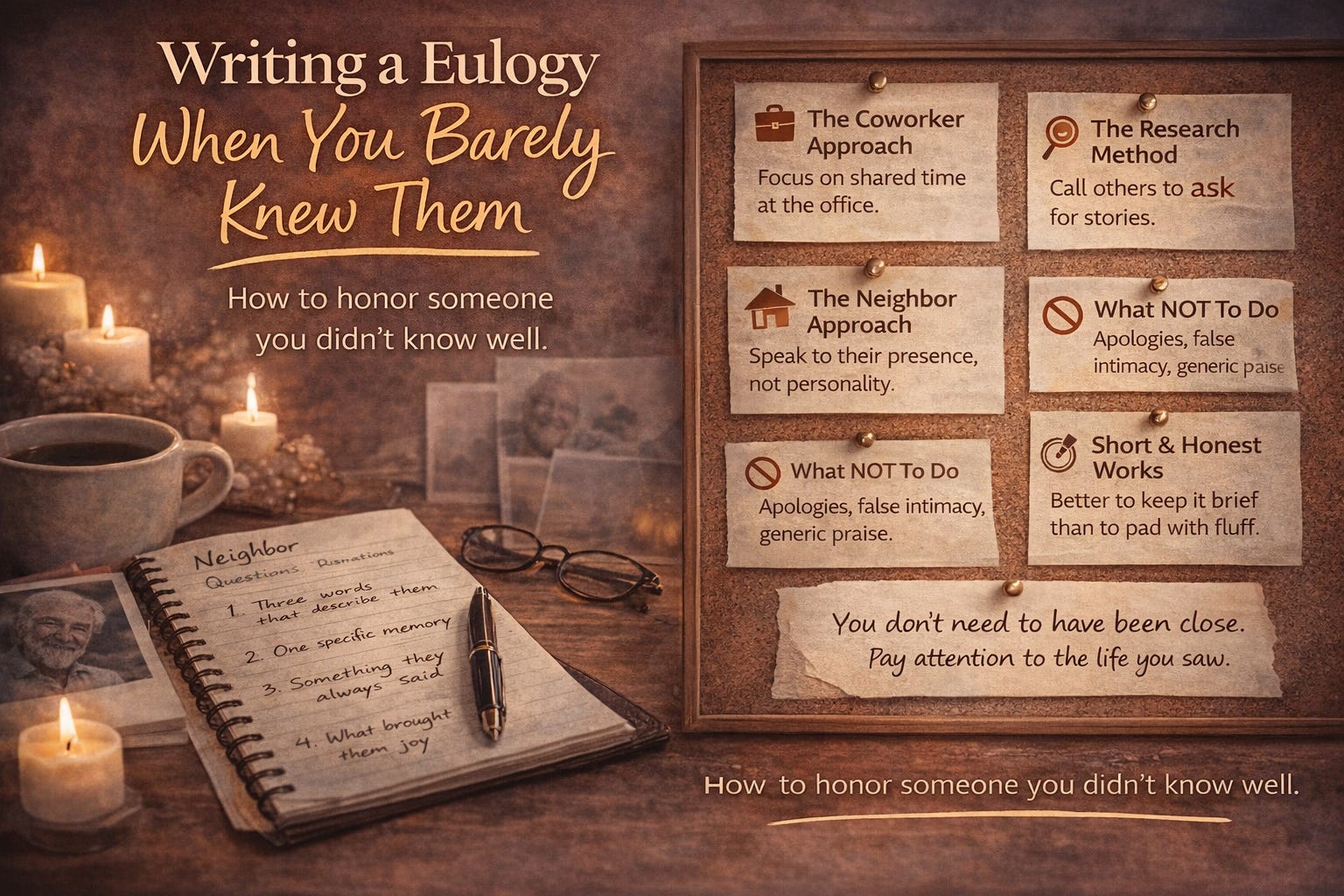
You want to say something meaningful. You do not want to fake intimacy you did not have. And you are panicking because you have three days and six usable memories.
This is the guide for that exact situation.
First: You Are Enough
The fact that you were asked means something. Someone believed you could honor this person. That belief is usually correct — the people who worry most about doing a good job are the ones who do the best job.
You do not need to have been their closest friend. You need to have paid attention.
So, let’s think through how you can do this.
The Coworker Eulogy
This is the most common version of the “barely knew them” speech. You worked with someone for years. You sat in meetings together, ate lunch in the same break room, exchanged pleasantries. Then they died and you realized you knew them well enough to miss them but not well enough to describe them to a stranger.
What you probably do know:
How they handled stress.
Their routine (what was on their desk, what they ate for lunch, how they started meetings).
A moment where they surprised you.
How they treated people who could not do anything for them.
What the office feels like without them.
The approach: Frame the eulogy around the limited window you had. Do not pretend you had more.
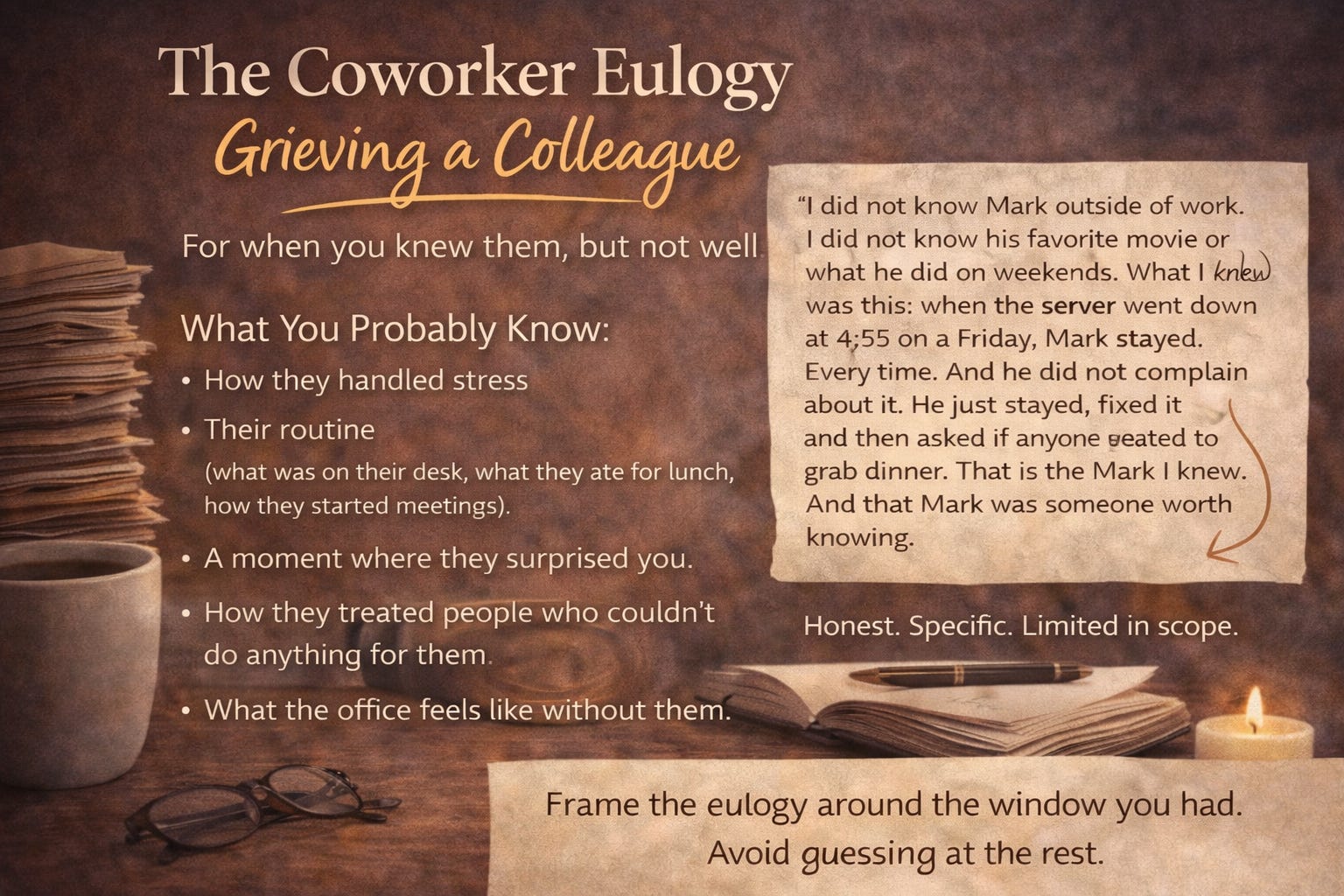
I did not know Mark outside of work. I did not know his favorite movie or what he did on weekends. What I knew was this: When the server went down at 4:55 on a Friday, Mark stayed.
Every time. And he did not complain about it. He just stayed, fixed it, and then asked if anyone wanted to grab dinner.
That is the Mark I knew. And that Mark was someone worth knowing.
Honest. Specific. Limited in scope. Complete.
The Distant Relative Speech
You are speaking about a great-aunt you saw at Thanksgiving, a cousin twice-removed, a step-grandparent who married into the family after you were grown.
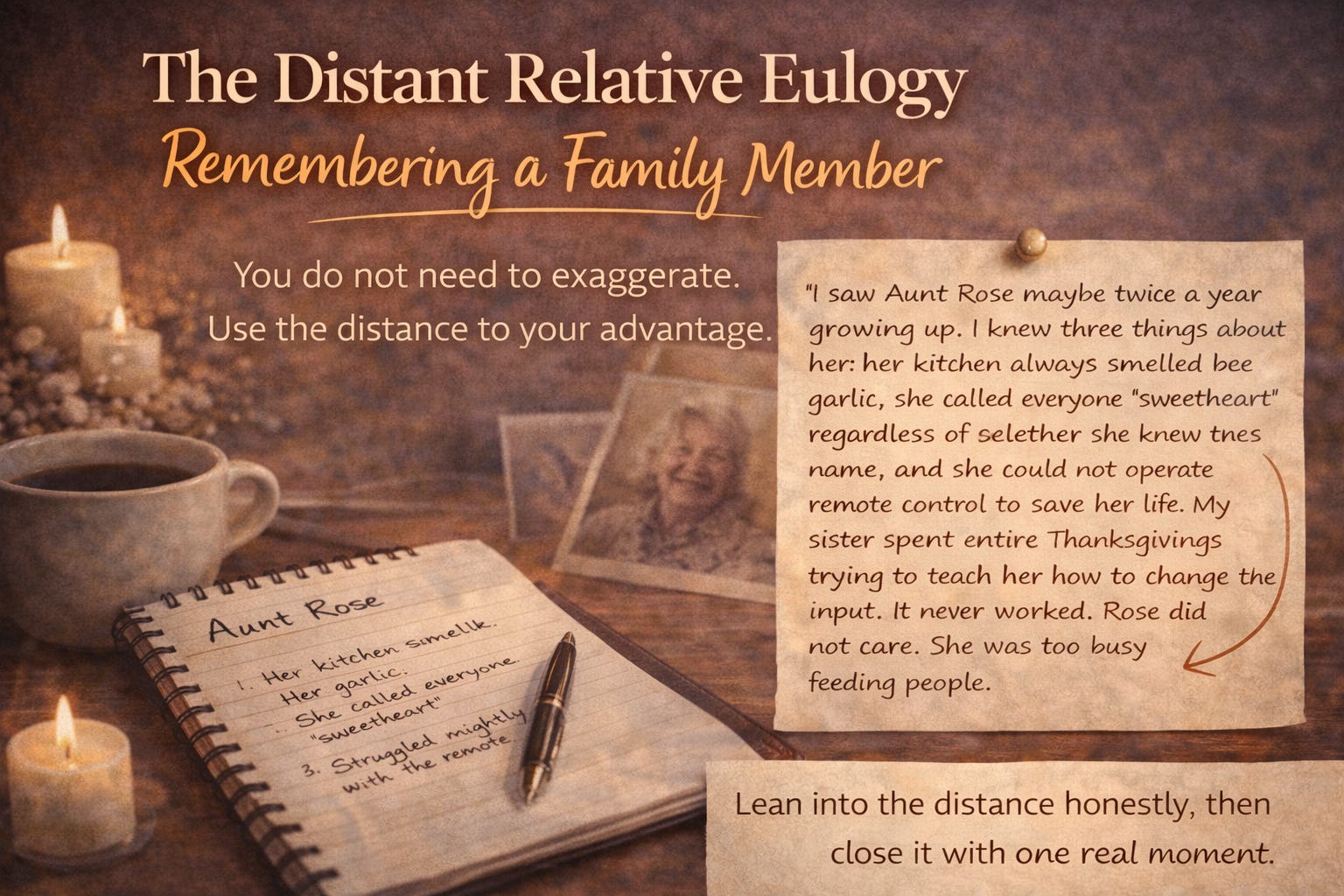
What you probably have:
A handful of family gathering memories
A physical description (their laugh, their kitchen, what their house smelled like)
Stories other family members have told you
One genuine human moment between the two of you
The approach: Lean into the distance honestly, then close it with the one real moment.
I saw Aunt Rose maybe twice a year growing up. I knew three things about her: The kitchen always smelled like garlic, she called everyone “sweetheart” regardless of whether she knew their name, and she could not operate a remote control to save her life.
My sister spent entire Thanksgivings trying to teach her how to change the input. It never worked. Rose did not care. She was too busy feeding people.
The distance is not a weakness. It is a lens. You saw them from farther away, which sometimes means you saw things the people close to them missed.
The Neighbor / Community Member Speech
You shared a street, a church pew, a PTA committee. You waved from driveways. You knew their dog’s name but not their birthday.
The approach: Community eulogies work best when they focus on presence rather than personality. You did not know their inner world, but you knew what it felt like to have them in yours.
Every morning for seven years, I watched Jim walk his dog past my house at exactly 7:15am.
Rain, snow, August heat. 7:15am, Jim and the dog. I never asked him about it.
But on the mornings when I was running late and I looked out the window and saw Jim, I knew the world was still working. That kind of reliability does not make headlines.
But it builds a neighborhood.
The Research Method
When you do not have enough personal material, become a journalist.
Call 2-3 people who knew them well. Ask them these questions:
Three words that describe them…
One specific memory…
Something they always said…
What brought them joy…
Their gift to others…
You will get material you never would have had on your own. And you can weave multiple perspectives into the eulogy: “His daughter told me he...” “A friend of thirty years said...”
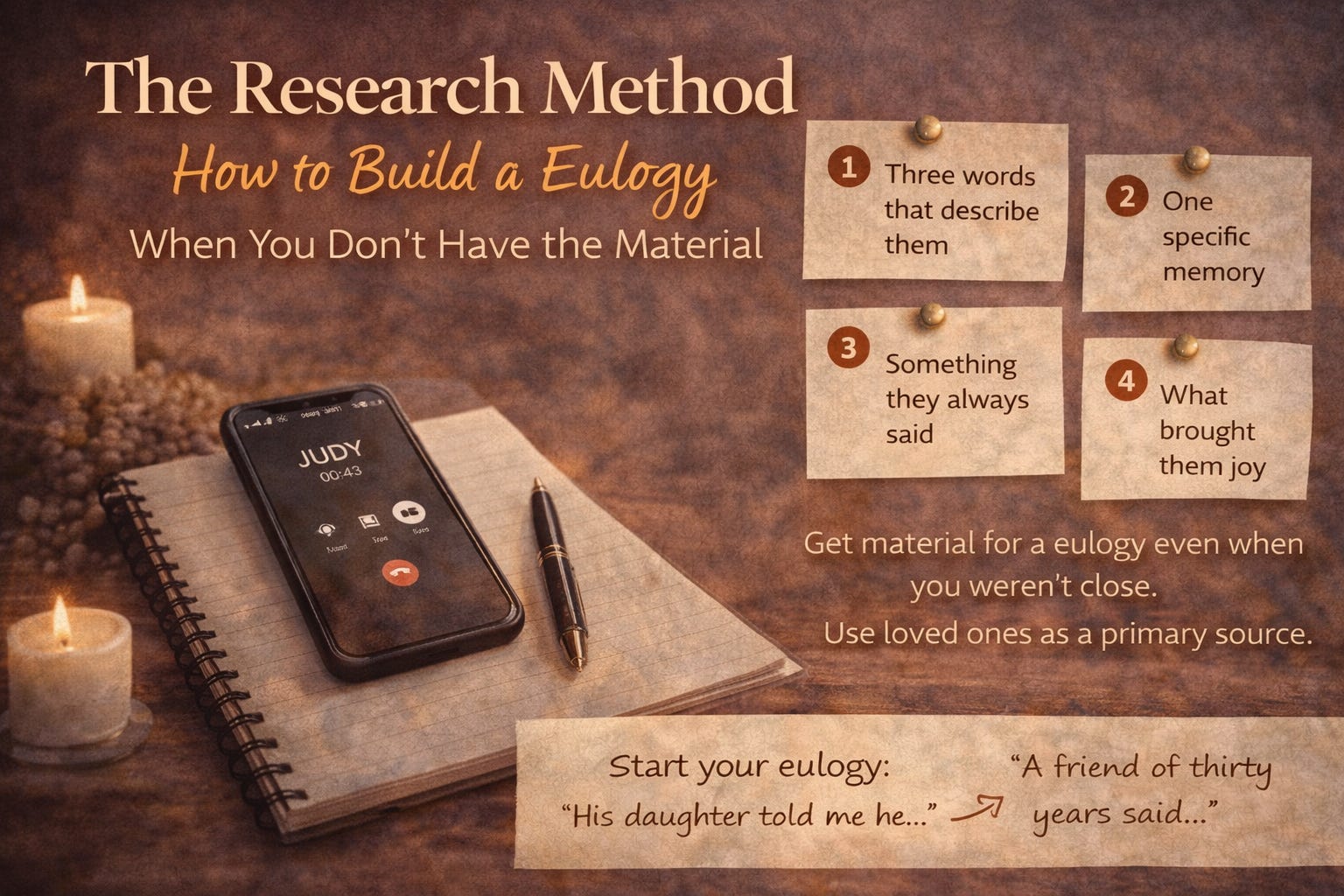
This is not cheating. This is how journalism works. You are gathering primary sources and weaving them into a narrative. The eulogy becomes richer because it contains more than one viewpoint.
What Not To Do
Do not pretend you were closer than you were. The family knows. The room knows. False intimacy is worse than honest distance.
Do not pad with generic praise. “He was a wonderful person who will be deeply missed” is the eulogy equivalent of a participation trophy. It costs nothing and means nothing.
Do not make it about you. “I wish I had gotten to know him better” is about your regret, not their life. Focus outward.
Do not apologize for your distance. “I did not know her as well as some of you” -- the room does not need your disclaimer. They need your contribution.
The Short Eulogy Is Fine
If you only have 2 minutes of genuine material, give 2 minutes. A short, honest speech is infinitely better than a padded one.
The worst eulogies I have ever encountered are not the short ones. They are the ones where someone had 3 minutes of real content and stretched it to 8 with filler. The room can feel the padding. They start thinking about the parking meter.
Target: 300-500 words for a “barely knew them” speech. That is 2-3 minutes. Enough to be meaningful, short enough to be honest about your scope.
Use the Tool
Our eulogy generator which works especially well for this situation. The 8 questions force you to find the specific details you do have, even if you did not think you had them.
You might not know their three words immediately. But sit with it. Think about the two or three interactions you had. Something will surface. Their laugh. The way they greeted you. The one time they said something that stuck.
That is enough. That is always enough.
The tool gives you a structured draft in 5 minutes. Then you edit it to be honest about your relationship while still honoring the person. That combination — structure plus honesty — is exactly what this situation requires.
Free. 2 generations per day. 4 tones. Full editor.
You were asked because someone believed you could do this. They were right.
— 8